
Attention Channeling
A lapsed patient receives a message saying 'We'd love to see you back, book your next appointment today.' They glance at it, feel vaguely guilty, and move on. Now consider a different approach: that same patient first receives a message asking, 'On a scale of 1-10, how would you rate your lower back pain right now compared to when you finished treatment?' Suddenly, they're paying attention, to their body, to their discomfort, to the gap between where they are and where they want to be. That single shift in focus changes everything about what happens next.
The Science Behind Attention Channeling
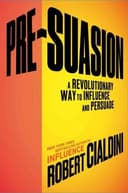
Attention Channeling is a pre-suasion principle developed and articulated by renowned social psychologist Robert Cialdini in his 2016 book *Pre-Suasion: A Revolutionary Way to Influence and Persuade*. The core insight is deceptively simple: whatever captures a person's attention in the moment before a request is made becomes perceived as more important, more relevant, and more urgent. You are not just communicating information, you are constructing the mental context through which your message will be received. The question is not only *what* you say, but *what you cause someone to think about* before you say it.
The psychology behind this principle rests on a fundamental quirk of human cognition. Our brains are not objective processors of information; they are meaning-making machines that use whatever is most salient in working memory to interpret new stimuli. When you direct someone's attention toward a particular concept, pain, mobility, physical decline, the memory of feeling better, that concept becomes the interpretive lens for everything that follows. Cialdini draws on decades of cognitive and social psychology research to demonstrate that this 'privileged moment' of focused attention dramatically increases the persuasive impact of any subsequent message. In essence, you are priming the reader's mind so that your call to action lands in the most fertile possible psychological soil.
This is distinct from simple reminder marketing. A reminder says, 'Here is a thing you could do.' Attention Channeling says, 'Here is how you feel right now, and now here is what you could do about it.' The first addresses the calendar; the second addresses the body. For allied health practitioners, this distinction is everything. Patients don't avoid rebooking because they've forgotten your phone number. They avoid rebooking because their pain has temporarily subsided, life has gotten busy, and the felt urgency has faded. Attention Channeling restores that urgency by redirecting focus to the physical reality the patient is actually living in.
Cialdini's framework is grounded in what he calls 'pre-suasive channelling', the deliberate act of directing attention to a concept that is naturally associated with the desired behaviour. If you want someone to value their health, draw their attention to their health before you make your ask. If you want someone to feel the importance of ongoing care, ask them to assess their own body before you offer them the opportunity to book. The sequence is not manipulative; it is simply an honest alignment between what the patient already cares about and the action you are inviting them to take.
The Research
One of the most compelling demonstrations of attention channelling cited by Cialdini involves a study on charitable giving conducted by researchers examining the power of a single focusing question. Before being asked to donate to a charity supporting the disabled, one group of participants was first asked, 'Do you consider yourself a helpful person?' This seemingly innocuous question, which simply directed attention toward their own identity as a helpful individual, nearly doubled the donation rate compared to participants who were asked for a donation without the prior attention-focusing question. The question did not add new information, offer incentives, or apply social pressure. It simply created a momentary mental frame. Once participants were focused on their own helpfulness, agreeing to a helping-oriented request felt entirely consistent with the self-concept they had just activated.
This finding is directly transferable to patient re-engagement. When you ask a lapsed patient to reflect on their physical state, 'Can you move as freely as you could when you finished your last course of treatment?', you are not adding pressure or guilt. You are simply directing their attention to something they genuinely care about: their own body and wellbeing. Once that focus is established, a rebooking invitation doesn't feel like a sales pitch. It feels like a natural, logical response to the very thing they were just thinking about.
How to Apply This in Your Practice
The practical application begins before you ever mention the word 'appointment.' Your re-engagement sequence should open with a self-assessment prompt, a short, genuine question that invites the patient to turn their attention inward. For a physiotherapy or chiropractic practice, this might look like an SMS or email that reads: 'Hi [Name], quick question, on a scale of 1 to 10, how would you rate your [lower back / knee / neck] comfort today compared to when you completed your last treatment with us? We'd love to know how you're tracking.' This message does three things simultaneously: it acknowledges the patient's history with your practice, it channels their attention directly to their physical state, and it creates a micro-commitment through the act of self-reflection. Critically, it asks nothing of them yet.
Once the patient has engaged with that first message, or even simply read it, the follow-up message lands in a completely different psychological context. Now you send: 'Thanks for checking in with yourself. If you've noticed any tightness, discomfort, or a reduction in your range of motion creeping back, that's completely normal, and it's exactly what we're here to help with. We have appointments available this week if you'd like to come in and get assessed.' Notice how the rebooking offer now feels like a direct response to what the patient was just thinking about. You haven't changed your offer; you've changed the mental frame in which it is received. The science tells us this sequence dramatically increases the likelihood of action compared to a cold rebooking request.
For podiatry and massage therapy practices, the same principle applies with condition-specific prompts. A podiatry clinic might send: 'Before we say anything else, can you stand comfortably for 30 minutes without your feet aching? If the answer has changed since your last visit, it might be time to check in.' A remedial massage therapist might ask: 'How's your shoulder tension been this week? Rate it 1-5 compared to how you felt after your last session.' The specificity of these prompts matters enormously. Generic wellness questions do not channel attention with the precision needed to create pre-suasive momentum. The question must connect directly to the patient's presenting condition and their lived experience of their own body.
From a workflow perspective, this approach integrates naturally into any practice management software that supports automated messaging. Segment your lapsed patients by their original presenting condition and schedule a two-part automated sequence: message one is the self-assessment prompt (sent 6-12 weeks post-discharge, depending on the condition), and message two is the rebooking invitation (sent 24-48 hours later, whether or not the patient replied). The pause between messages is itself a feature, not a bug, it gives the patient time to notice their physical state in real life, reinforcing the attention-channelling effect before your booking invitation arrives.
Get one behavioral science principle per week
Applied to patient retention. Backed by research. No fluff.
Seeing It in Action
Consider a fictional patient, let's call her Priya, a 38-year-old school teacher who completed a six-session course of physiotherapy for chronic neck pain at a Melbourne clinic eight weeks ago. She finished treatment feeling significantly better, but in the weeks since, the demands of the school term have crept back in: long hours at a desk, marking papers on the couch, and the familiar tension building behind her left shoulder. She hasn't rebooked because she doesn't feel as bad as she did when she first came in, but she's nowhere near as mobile or comfortable as she was at the end of her treatment program.
The clinic sends Priya an automated SMS: 'Hi Priya, it's been a couple of months since we last saw you, and we're curious: how's your neck mobility feeling compared to when you finished up with us? Can you turn your head easily to check your blind spot while driving? Give it a try and notice how it feels.' Priya reads this on her lunch break, absently rolls her neck, and immediately notices the familiar catch on the left side. She hadn't been consciously aware of how much it had returned until that moment. Twenty-four hours later, a follow-up message arrives: 'If your neck has been tightening back up, that's completely normal, and much easier to address now than later. We have a few spots available this week if you'd like to get ahead of it. Reply YES and we'll send you a booking link.'
Priya books that afternoon. From the clinic's perspective, nothing unusual happened, no discounts were offered, no pressure was applied, no elaborate campaign was run. But from a behavioural science perspective, everything about the sequence was engineered for effectiveness. The self-assessment prompt channelled Priya's attention to exactly the physical reality that made the rebooking offer immediately relevant. The offer didn't interrupt her day; it answered a question her own body had just raised.
Your Action Plan
- 1Segment your lapsed patient list by presenting condition (e.g., lower back pain, neck tension, plantar fasciitis) so your attention-channelling prompts can be specific and physically relevant rather than generic.
- 2Write a self-assessment question for each condition segment, something that invites the patient to physically check in with their body right now, such as 'Can you bend forward and touch your knees comfortably?' or 'How does your ankle feel after a full day on your feet?'
- 3Set up a two-message automated sequence in your practice management system: message one delivers the self-assessment prompt at 6-10 weeks post-discharge; message two delivers the rebooking invitation 24-48 hours later, referencing the self-reflection you prompted.
- 4Write your rebooking invitation so it directly follows from the attention-channelling question, frame the appointment as a natural response to what they were just asked to notice, not as a standalone promotional offer.
- 5Review reply rates and booking conversions for this sequence against your previous rebooking approach, then refine your self-assessment questions based on which conditions and phrasings generate the highest re-engagement rates.
Key Takeaway
Before you ask a lapsed patient to rebook, ask them to notice their own body, because attention directed to discomfort makes the solution you're offering feel not like a sales pitch, but like an answer.
Related Principles
Privileged Moments: Time Outreach for Maximum Receptivity
Pre-Suasion · Robert B. Cialdini
There are identifiable windows in time when people are most receptive to a message. The same offer can produce drastically different results depending on when i
Priming Through Association: Prime Patients with Success Stories Before Rebooking
Pre-Suasion · Robert B. Cialdini
Exposure to certain words, images, or concepts primes people to respond in predictable ways. The environment shapes the response.
Triggers (Environmental Reminders): Link Rebooking to Everyday Physical Sensations
Contagious · Jonah Berger
Ideas spread when they are linked to frequent environmental triggers. The more often something is triggered, the more it stays top-of-mind.
Direct the Rider: Find the Bright Spots: Study What Successful Patients Do Differently
Switch · Chip Heath & Dan Heath
Instead of analyzing problems, find what's already working and replicate it. Study successes, not failures.