
The Generation Effect

Your lapsed patients already know something is wrong, their knee aches climbing stairs, their back twinges when they pick up the kids, their shoulder clicks every morning. The problem isn't that they lack awareness; it's that they haven't been asked the right question to surface it. There's a powerful principle from cognitive psychology that explains why telling patients they need to come back almost never works, and what to do instead.
The Science Behind The Generation Effect
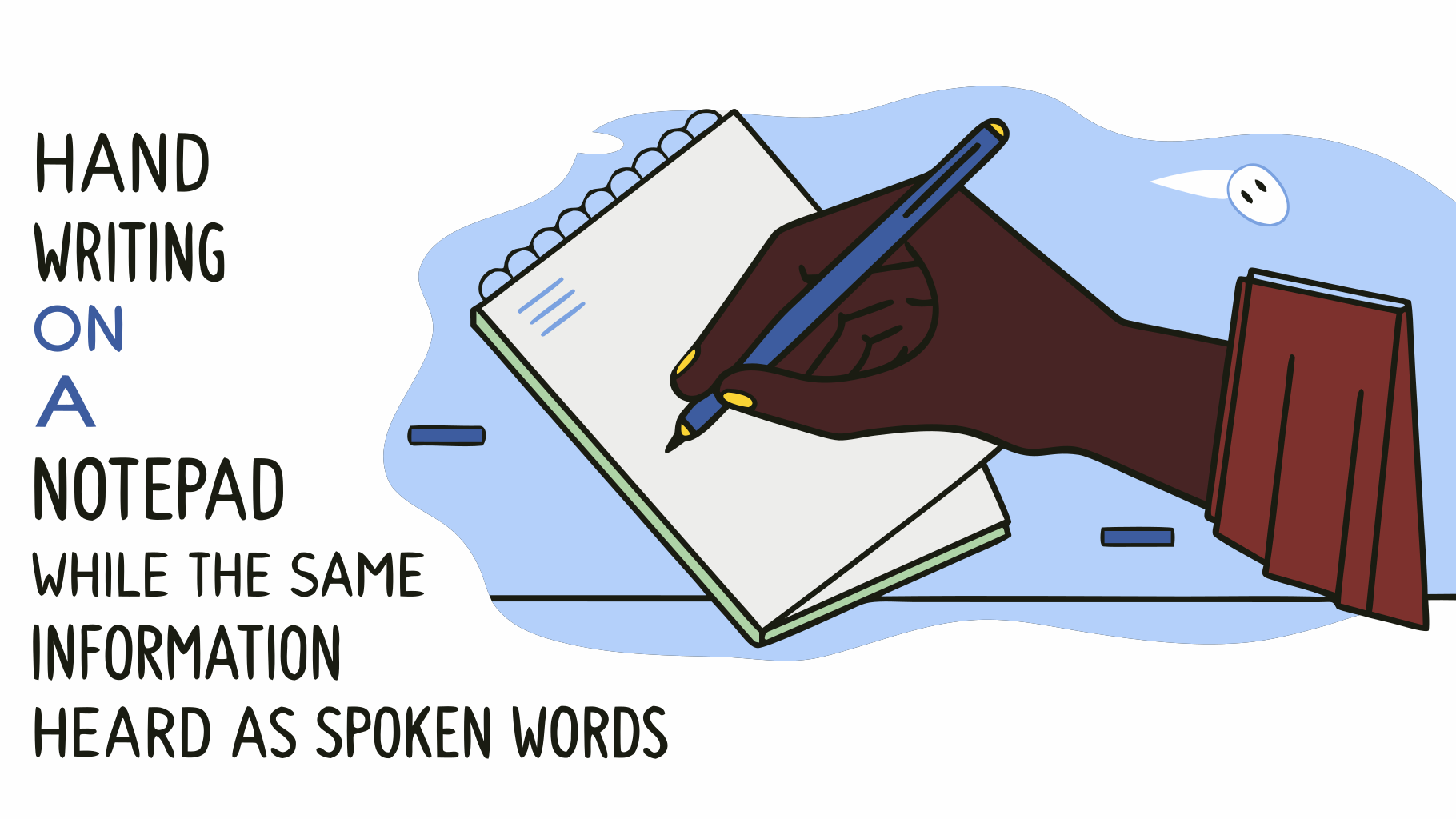
The Generation Effect is a well-documented phenomenon in memory research: information that a person actively generates themselves is retained significantly better than information they passively receive. In other words, if you tell someone a fact, they'll likely forget it. But if you guide them to arrive at that same fact themselves, through a question, a prompt, or a problem to solve, it sticks. The effect was formally described by researchers Slamecka and Graf in 1978, and it has since been replicated across dozens of studies in cognitive psychology. The mechanism is rooted in what researchers call 'elaborative encoding': when your brain works to produce an answer, it creates richer, more deeply connected memory traces than when information is simply absorbed.
Richard Shotton explores the Generation Effect in his 2022 book 'The Illusion of Choice', framing it as one of the most underused tools in marketing and persuasion. Shotton points out that most communication is built around transmission, someone with information sends it to someone without. Advertising tells you a product is great. A GP tells you to exercise more. A physio clinic sends an SMS reminding you to book. But transmission is cognitively cheap for the recipient, which means it's also cognitively forgettable. The Generation Effect flips this dynamic: instead of delivering a conclusion, you create the conditions for someone to reach that conclusion themselves.
The psychological depth here goes beyond simple memory. When people generate their own answers, they also experience greater ownership of those conclusions. This is related to what psychologists call the 'IKEA effect', we value things more when we've had a hand in creating them. Applied to health behaviour, this means a patient who self-generates the realisation that their mobility has declined over six months will feel that insight more acutely, and be more motivated to act on it, than a patient who receives a generic message saying 'it's time for a check-up.' The insight belongs to them. It doesn't feel like being sold to; it feels like self-discovery.
For allied health practices, where the central challenge is often motivating people who don't feel acutely unwell enough to prioritise treatment, the Generation Effect offers a practical and ethically sound strategy. Your lapsed patients aren't indifferent, they're unactivated. The right prompt, delivered at the right moment, can surface a concern they've been quietly carrying and translate it into a booking decision.
The Research
The foundational experiment demonstrating the Generation Effect was conducted by Norman Slamecka and Peter Graf in 1978, published in the Journal of Experimental Psychology: Human Learning and Memory. Participants were given word pairs and asked to either read the second word (passive condition) or generate it based on a rule, for example, given the word 'rapid' and the first letter 'f', they had to generate 'fast' themselves. When memory was tested later, participants consistently recalled self-generated words at significantly higher rates than words they had simply read. The effect was robust across multiple experiments and memory test types, and it has since been replicated in educational, clinical, and consumer behaviour contexts.
Shotton's application of this research to persuasion and marketing highlights something particularly relevant for healthcare communication: the Generation Effect doesn't require elaborate effort from the person being prompted. Even a simple question, one that takes ten seconds to answer, is enough to trigger the deeper encoding that makes the resulting insight memorable and motivating. The implication for patient re-engagement is significant: a well-crafted question sent to a lapsed patient may do more cognitive and motivational work than a beautifully designed email campaign telling them exactly why they should return.
How to Apply This in Your Practice
The most direct application of the Generation Effect in allied health is to replace declarative re-engagement messages with generative ones. Instead of sending a lapsed patient an SMS that reads 'It's been 6 months since your last appointment, book now to stay on top of your health,' try something like: 'Quick question for you, [Name], on a scale of 1 to 10, how would you rate your mobility or comfort compared to when we last saw you?' That single shift, from telling to asking, changes the patient's cognitive role from passive recipient to active participant. They now have to think, compare, and evaluate. That process of generation is where the magic happens.
You can build a simple two-step re-engagement workflow around this principle. Step one is the generative prompt, delivered via SMS or email at a natural lapse interval (say, 90 or 180 days post-last-appointment). The prompt should be low-effort to answer and personally relevant. Good examples include: 'What's one physical activity you used to do easily that feels harder now than it did six months ago?' or 'If you had to score your back/knee/shoulder out of 10 today, what would you give it?' Step two is a warm, human follow-up based on their response. If they reply with a 6 out of 10, your response might be: 'Thanks for sharing that, a 6 suggests there's some room to get you feeling better. Would you like to book a session to work on that?' The patient has now generated their own evidence of decline, and your follow-up simply connects that insight to a solution.
The principle also applies to intake and re-activation conversations within the clinic. When a patient returns after a long gap, resist the urge to tell them what's changed or what you've observed. Instead, ask them to articulate it: 'What have you noticed in your body since we last worked together?' or 'What's the activity that first made you realise you needed to come back?' These questions serve a dual purpose, they give you clinically useful information, and they cause the patient to verbalise their own experience of decline, which research suggests increases their motivation to address it. You're not convincing them; you're helping them convince themselves.
From a workflow integration standpoint, the Generation Effect is well-suited to automation without losing its personal feel. Platforms like Routiq allow practices to trigger personalised question-based messages at defined intervals post-appointment. The key is to ensure the question feels like it comes from a human who remembers the patient, not a bulk marketing system. Personalisation tokens (using the patient's first name, referencing their presenting complaint) significantly increase the likelihood of engagement. Even a response rate of 20-30% to a generative prompt can meaningfully outperform a standard recall message, because the patients who do respond are self-qualifying, they've already begun the psychological work of reconnecting with their health concern.
Get one behavioral science principle per week
Applied to patient retention. Backed by research. No fluff.
Seeing It in Action
Consider Sarah, a 44-year-old project manager who completed a course of physiotherapy treatment for a lower back issue eighteen months ago. She was discharged in good shape, given a home exercise programme, and told to return if symptoms recurred. Life got busy. The exercises gradually fell away. Her back has been grumbling for a few months, not badly enough to feel urgent, but consistently enough to be noticeable. She hasn't booked because she's not sure it's 'bad enough,' and the idea of calling a clinic feels like one more thing on an already full to-do list. A standard recall SMS, 'Hi Sarah, it's been a while! Book your check-up today', sits unread in her inbox.
Her physiotherapy practice, using Routiq's automated re-engagement workflows, sends Sarah a different kind of message at the 12-month mark: 'Hi Sarah, quick question. Think back to when you finished with us last year. On a scale of 1 to 10, how does your back feel today compared to then?' Sarah reads it while waiting for a coffee. She pauses. She actually thinks about it. She types back: '5, it's been playing up a bit.' The clinic's patient coordinator responds within the hour: 'Thanks for being honest about that, Sarah. A 5 tells us there's definitely some room to get you back to your best. We have a few spots this week, would Thursday or Friday work for you?'
Sarah books. Not because she was told to. Not because of a discount or a reminder. But because a simple question made her generate her own evidence that something had slipped, and the practice was there, ready and warm, when that insight surfaced. She attends the appointment, resumes a maintenance plan, and becomes one of the practice's most reliably retained patients. The Generation Effect didn't manufacture her concern, it simply gave it a moment to become conscious.
Your Action Plan
- 1Audit your current re-engagement messages and identify any that are purely declarative ('It's time to book', 'Don't forget your health'). Flag these as candidates for a generative rewrite.
- 2Craft 2-3 generative prompt templates tailored to your most common patient presentations (e.g., back pain, sports injuries, chronic conditions). Each prompt should ask patients to rate, recall, or compare, not just receive information.
- 3Set up automated triggers in your practice management or patient engagement platform (such as Routiq) to send generative prompts at defined lapse intervals, 90 days, 180 days, and 12 months post-last-appointment.
- 4Train your reception and patient coordination team to respond to generative prompt replies promptly and warmly, using the patient's self-generated insight as the bridge to a booking conversation rather than defaulting to a scripted sales response.
- 5Review response and conversion rates on generative prompts quarterly, comparing them against your previous recall message benchmarks, and iterate your question wording based on which prompts generate the highest reply and booking rates.
Key Takeaway
When you stop telling lapsed patients what they need and start asking questions that help them discover it themselves, you harness a fundamental truth of human memory and motivation: we act on what we generate far more powerfully than on what we're told.
Related Principles
Extremeness Aversion: Present Three Options to Guide the Middle Choice
The Illusion of Choice · Richard Shotton
People avoid extreme options and gravitate toward the middle. When presented with three choices, the middle option is disproportionately selected.
The Precision Effect: Use Precise Numbers for More Credible Messages
The Illusion of Choice · Richard Shotton
Precise numbers are more credible than round numbers. "$97" feels more calculated and trustworthy than "$100."
Scarcity: Use Limited Availability to Drive Appointment Urgency
Influence · Robert B. Cialdini
People assign more value to opportunities that are limited in availability. Fear of missing out drives action.
The Decoy Effect (Asymmetric Dominance): Structure Pricing to Guide Patient Commitment
Predictably Irrational · Dan Ariely
When choosing between two options, adding a third "decoy" option that is clearly inferior to one of them makes the superior option far more attractive.