
The Peak-End Rule

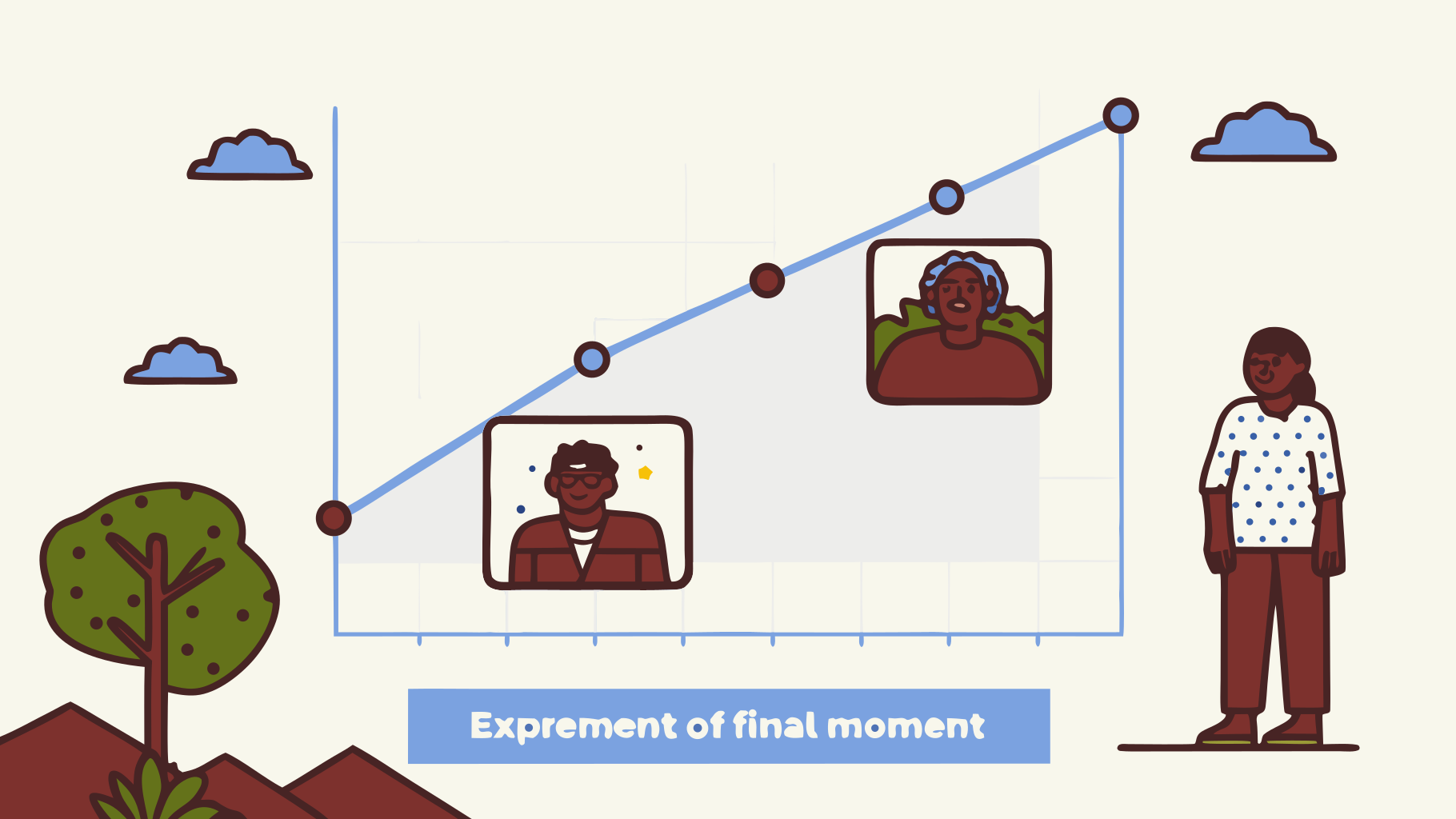
Your patient leaves feeling better than when they arrived, but six months later, they haven't booked again. You assume they recovered and moved on. But what if the real reason they haven't returned is far simpler, and far more fixable: they can't quite remember why they liked coming to see you? The Peak-End Rule, one of the most robust findings in behavioural psychology, reveals that patients don't remember your sessions accurately, they remember them in a very specific, predictable way, and your re-engagement strategy needs to account for that.
The Science Behind The Peak-End Rule
The Peak-End Rule is a cognitive bias first identified by Nobel Prize-winning psychologist Daniel Kahneman and his colleague Barbara Fredrickson in the early 1990s. It describes a consistent quirk in how human memory works: when we look back on an experience, we don't mentally average out every moment from start to finish. Instead, our brain takes two shortcuts, it latches onto the most emotionally intense moment of the experience (the 'peak') and the way the experience ended. Everything in between, including the duration of the experience, gets substantially discounted. This is the 'duration neglect' aspect of the rule, and it has profound implications for any service business where patients keep, or abandon, their care.
The psychology behind this principle sits at the intersection of how memory and emotion interact. Kahneman's broader research on the 'experiencing self' versus the 'remembering self' shows that it's the remembering self, the story we construct after the fact, that drives our future decisions. In practical terms, this means a patient's decision to rebook, refer a friend, or respond to a re-engagement message is not based on a balanced assessment of their entire treatment journey. It is based on a reconstructed emotional highlight reel: the moment they felt most cared for or most relieved, and how things felt when they walked out the door on their final visit. Richard Shotton, in his 2018 book The Choice Factory, draws on this research to argue that marketers and service providers systematically underinvest in peaks and endings, while over-investing in the middle of the customer journey.
For allied health practitioners, physiotherapists, chiropractors, osteopaths, podiatrists, remedial massage therapists, this finding reframes the entire patient experience design problem. You might be delivering genuinely excellent clinical outcomes across a six-session course of treatment, but if the final appointment ends with a rushed goodbye, an awkward silence in reception, or a vague non-committal about follow-up care, that underwhelming ending becomes disproportionately powerful in shaping how the patient remembers you. The clinical excellence gets averaged out. The flat ending sticks.
Critically, the Peak-End Rule also explains why lapsed patients can be surprisingly receptive to re-engagement outreach, even after long absences. If their last appointment ended on a warm, encouraging, memorable note, that positive ending is likely still the emotional anchor for how they remember your practice. Months later, when they receive a thoughtful message from you, that memory activates. The barrier to returning is lower than you might expect, because their remembered experience is better than any neutral alternative.
The Research
The most well-known experimental demonstration of the Peak-End Rule comes from Kahneman, Fredrickson, Schreiber, and Redelmeier's 1993 study examining patients undergoing colonoscopies, a procedure that is uncomfortable but varies in intensity and duration. Patients were randomly assigned to two conditions. In one condition, the procedure ended when the clinical work was complete. In the other, the scope was left in place for an additional 60 seconds at the end, but held still, meaning patients experienced extra time of mild, though still uncomfortable, sensation. Counterintuitively, patients in the second group, who objectively experienced a longer and therefore worse procedure by total discomfort, rated the overall experience as significantly less unpleasant. Because the procedure ended at a lower peak of pain rather than an abrupt high-intensity finish, their remembered experience was kinder. They were also more likely to return for a follow-up procedure when recommended by their doctor.
This study is remarkable not just because of what it found, but because of what it disproves. It dismantles the intuitive assumption that more discomfort equals worse memory, and more time equals worse experience. Duration barely mattered. The ending mattered enormously. For any allied health practitioner who has ever wondered whether a slightly longer, gentler wind-down to an appointment is worth the schedule pressure, this research provides a compelling answer.
How to Apply This in Your Practice
The first and most fundamental application is redesigning how every appointment ends, not just as a nicety, but as a deliberate clinical and business strategy. The final two to three minutes of each consultation are disproportionately powerful in shaping patient memory. Train every practitioner and reception staff member to treat the farewell as a clinical moment, not an administrative one. This means the practitioner, not just the front desk, offers a specific, personalised observation about the patient's progress before they leave. Something like: 'I want you to know, the improvement in your hip flexion since your first session has been really solid, you should feel good about the work you've put in.' This is not flattery; it is a strategically placed positive peak, anchored to a real outcome, delivered at the exact moment when memory encoding is most active.
For re-engaging lapsed patients specifically, the Peak-End Rule gives you a powerful insight: the message you send them should mirror the emotional quality of a good ending. A bland recall SMS, 'Hi [Name], it's been a while, would you like to book?', fails to activate any memory anchor. Instead, your outreach should evoke the positive experience they had. Consider message copy along these lines: 'Hi Sarah, it's been a few months since we last saw you. We were genuinely pleased with the progress you made with your lower back, if anything's flared up again, or you'd just like a maintenance check-in, we'd love to see you back. Reply here or call us to book.' This message does three things: it personalises the recall, it references a positive remembered experience, and it reduces the perceived barrier to returning by framing it as a low-stakes check-in.
From a workflow perspective, this requires your practice management system to capture meaningful clinical notes that can inform personalised re-engagement messages, not just diagnosis codes, but progress milestones and patient goals. Platforms like Routiq can automate the timing and delivery of these messages, but the language inside them must be informed by real patient data to activate Peak-End memory effectively. Build a simple template library that your practitioners contribute to: condition-specific message variants that reference common progress markers (reduced pain scores, return to activity, improved mobility) so that automated outreach still feels human and specific.
Finally, consider creating deliberate 'peak moments' earlier in the treatment journey that patients will carry into their memory of the whole experience. A practitioner who pauses mid-session to say, 'That's a really significant improvement from last week, your nervous system is responding well,' is engineering a positive peak. A reception team member who remembers a patient mentioned a weekend football game and asks how it went is creating an unexpected moment of warmth. These peaks, combined with strong endings, compound into a remembered experience that is resilient to the passage of time, making your lapsed patient re-engagement significantly more likely to succeed.
Get one behavioral science principle per week
Applied to patient retention. Backed by research. No fluff.
Seeing It in Action
Marcus, a 43-year-old project manager, completed a six-session course of physiotherapy at a suburban clinic in Brisbane for a recurring shoulder injury sustained during weekend rugby. His treatment was effective, by session five, his range of motion had measurably improved and he'd returned to light training. His final session, however, ended with his physio running slightly behind schedule. The discharge was quick: a printed home exercise programme handed over at reception, a polite 'see you if anything flares up,' and Marcus was out the door in under two minutes. Clinically, the treatment was a success. But the ending was flat.
Eight months later, Marcus hadn't rebooked despite some mild recurring tightness. He wasn't unhappy with the clinic, he just didn't feel a strong pull to return. When Routiq triggered an automated re-engagement message at the eight-month mark, the clinic's template read: 'Hi Marcus, it's been a while since your shoulder treatment, we hope you've been able to keep up with your rugby. If things have tightened up again or you'd like a maintenance session heading into the season, we'd love to catch up. Book online or reply to this message.' The message was warm, specific, and referenced his goal, returning to rugby, rather than just the injury.
Marcus replied within 48 hours and booked a maintenance appointment. When he arrived, his physio opened with a review of his previous progress notes and commented on how much he'd improved since the initial assessment. The session ended with a clear plan discussed face-to-face, a genuine 'really good to have you back,' and a follow-up appointment booked before he left reception. That ending, by design, was a peak. Marcus has since attended three further maintenance sessions and referred a colleague. The re-engagement worked not because of a discount or a clever promotional offer, but because the outreach activated a positive memory, and the return visit was engineered to end well.
Your Action Plan
- 1Audit your current appointment endings, shadow a session or review patient feedback to honestly assess whether your final two to three minutes are warm, personalised, and progress-focused, or rushed and transactional.
- 2Build a 'closing ritual' protocol for practitioners that includes one specific, personalised progress observation delivered verbally before the patient leaves, make this a clinical standard, not an optional courtesy.
- 3Capture meaningful progress milestones in your patient notes (pain score improvements, return to activity dates, patient-stated goals achieved) so that future re-engagement messages and return visits can reference real, positive memories.
- 4Rewrite your lapsed patient re-engagement message templates to evoke the patient's positive experience and reference their specific treatment goal or progress, rather than sending generic recall prompts, even a single personalised detail dramatically increases response rates.
- 5Set up automated re-engagement sequences in Routiq that trigger at clinically meaningful intervals (3, 6, and 12 months post-discharge), using condition-specific language that mirrors the emotional quality of a strong, encouraging appointment ending.
Key Takeaway
Patients don't remember your whole treatment, they remember the peak moment and the ending, so the last two minutes of every appointment and the first line of every re-engagement message are the most valuable clinical and business investments you can make.
Related Principles
The Pratfall Effect: Show Vulnerability to Build Patient Trust
The Choice Factory · Richard Shotton
People find individuals and brands more likable when they show a small, endearing flaw. Perfection creates distance; vulnerability creates trust.
The Fundamental Attribution Error: Blame the Situation, Not the Patient
The Choice Factory · Richard Shotton
We overestimate personality and underestimate context when explaining behavior. We assume people don't rebook because they "don't care," when the real reason is
Privileged Moments: Time Outreach for Maximum Receptivity
Pre-Suasion · Robert B. Cialdini
There are identifiable windows in time when people are most receptive to a message. The same offer can produce drastically different results depending on when i
Attention Channeling: Direct Patient Focus Before the Ask
Pre-Suasion · Robert B. Cialdini
Whatever captures attention is perceived as more important. Simply drawing focus to an idea increases its perceived significance.