
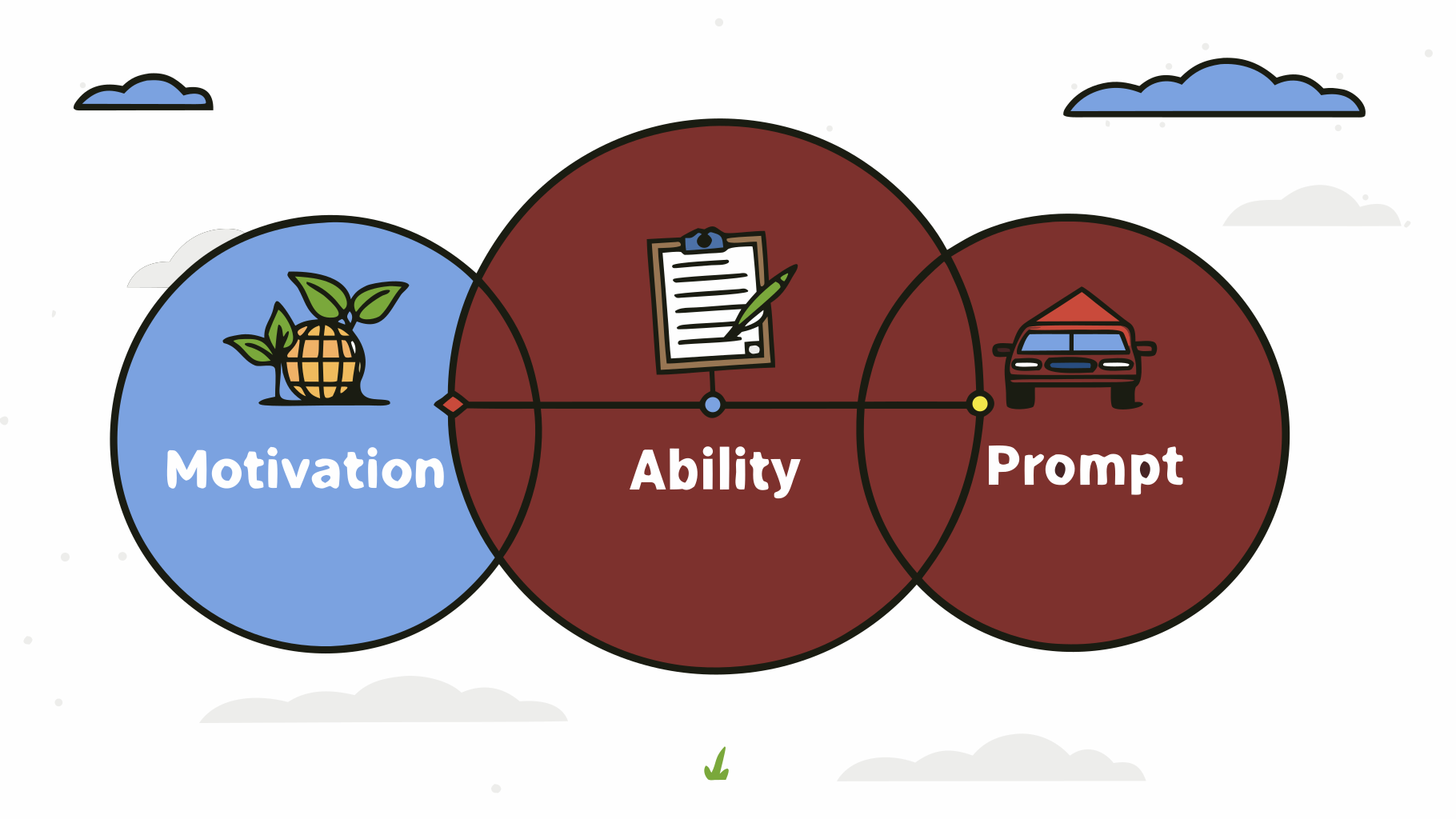
B=MAP (Behavior = Motivation x Ability x Prompt)

Right now, your practice management software is sitting on a goldmine, hundreds of patients who came to you with a problem, got some relief, and then quietly disappeared. You didn't lose them to a competitor. You didn't do anything wrong. They simply stopped coming back, and nobody prompted them to return. That silence is costing the average allied health practice tens of thousands of dollars every year, and the fix is simpler than you think, if you understand why people actually do things.
The Science Behind B=MAP (Behavior = Motivation x Ability x Prompt)
In 2019, Stanford behaviour scientist BJ Fogg published the culmination of two decades of research into human behaviour change. His central thesis, distilled into an elegant formula, states that Behaviour equals Motivation multiplied by Ability multiplied by a Prompt, B=MAP. The insight sounds deceptively simple: for any behaviour to occur, all three elements must be present at the same time. A patient can be highly motivated to book a follow-up appointment and have every ability to do so, but if nobody ever prompts them, the behaviour simply will not happen. Remove any single element from the equation, and the behaviour collapses to zero.
What makes Fogg's model so powerful, and so different from most advice about patient retention, is that it rejects the assumption that motivation is the primary lever. Most practice owners who notice a drop-off in returning patients instinctively assume the patient wasn't motivated enough, didn't value the treatment, or found someone cheaper. Fogg's research suggests this is rarely the culprit. Motivation fluctuates wildly from day to day and moment to moment. Someone can feel a surge of genuine intention to rebook while lying on your treatment table, and then completely forget about it by the time they reach the car park. Motivation, on its own, is profoundly unreliable as a driver of behaviour.
Ability is the second element, and it's where many allied health practices quietly fail their patients without realising it. Fogg describes a concept he calls 'motivation-ability trade-off': the harder a behaviour is to perform, the more motivation a person needs to do it. Conversely, make a behaviour extremely easy, and even modest motivation is enough to trigger it. If your rebooking process requires a patient to call during business hours, navigate a phone menu, be put on hold, and then negotiate appointment times verbally, you've created an ability barrier so high that only the most determined patients will clear it. Research in behavioural economics consistently shows that friction is one of the most powerful suppressors of desired behaviour.
The third element, the Prompt, is perhaps the most overlooked in healthcare settings. A Prompt is any signal, cue, or trigger that initiates a behaviour at a specific moment. Fogg distinguishes between person prompts (internal reminders, like feeling pain), context prompts (environmental cues), and action prompts (external triggers like a message or notification). The critical insight for your practice is this: you cannot reliably depend on patients to generate their own prompts. Waiting for a patient's pain to flare up badly enough that they self-motivate to call is a reactive, unpredictable strategy. An intentional, well-timed external prompt, sent to the right patient at the right moment, activates the entire MAP system and makes rebooking dramatically more likely.
The Research
One of the most compelling demonstrations of the MAP model comes from Fogg's own research programme at Stanford's Persuasive Technology Lab, where he ran a series of experiments testing what actually changes online behaviour. In one well-documented line of work, Fogg and his team found that the presence or absence of a well-timed trigger was often more predictive of whether someone completed a target behaviour than their self-reported motivation levels. Participants who expressed high motivation to perform a behaviour but received no trigger largely failed to act, while those with moderate motivation who received a clear, contextually appropriate prompt followed through at substantially higher rates. The research reinforced that motivation without a prompt is, in Fogg's words, like having a car with a full tank but no key in the ignition.
This finding has been replicated in healthcare contexts. Studies examining appointment adherence in outpatient settings have consistently shown that simple SMS reminders, a basic form of action prompt, reduce no-show rates by between 20 and 38 percent, according to reviews published in healthcare management literature. Critically, these patients didn't suddenly become more motivated when the text arrived; they already cared about their health. The prompt simply activated the behaviour that motivation alone had failed to trigger. The lesson for allied health practices is stark: the gap between a patient intending to rebook and actually rebooking is not a motivation gap, it's almost always a prompt gap, an ability gap, or both.
How to Apply This in Your Practice
Start your re-engagement audit by asking the most fundamental question first: are you actually sending prompts to your lapsed patients, and if so, when? A lapsed patient is typically defined as someone who hasn't attended in 90 days or more, though your ideal threshold will depend on the treatment type, a post-surgical rehabilitation patient is lapsed at six weeks; a remedial massage client might be lapsed at twelve weeks. Many practices have no systematic outreach at all. The first step is simply to fix the Prompt layer by implementing an automated, scheduled touchpoint. A well-crafted SMS sent at the 8-10 week mark, before the patient has fully disengaged, is significantly more effective than waiting until they've been absent for six months.
Once you're confident your prompt is reaching patients, examine your Ability layer ruthlessly. Put yourself in your patient's shoes at 7:30pm on a Tuesday night, having just read your message. Can they book in under 60 seconds from their phone? Do they land on a frictionless online booking page with real-time availability, or do they hit a 'call us during business hours' dead end? Fogg's research is unambiguous: every additional step you add to a behaviour reduces the probability of it occurring. Your re-engagement message should contain a direct, single-tap booking link, not a link to your homepage, not a link to a contact form, but a direct link that drops them straight into your online scheduler. If you don't have online booking, consider this your most urgent infrastructure investment.
The Motivation layer is where your message copy does its work, and this is where most practice re-engagement attempts fall flat. A message that says 'We noticed you haven't visited in a while, book online today' is technically a prompt, but it connects to nothing the patient cares about. Effective motivation-targeted messaging links the rebooking directly to the patient's original presenting concern or life goals. For example: 'Hi Sarah, it's been a couple of months since we worked on your lower back. With the gardening season starting up, now's a great time to get ahead of it, book a check-in here: [link].' This message works because it references something specific to Sarah (her lower back), connects to her life context (gardening), and frames the appointment as proactive rather than reactive.
The most sophisticated application of the MAP model is to segment your lapsed patient list and tailor each element accordingly. A 45-year-old tradesperson who presented with a shoulder injury has different motivational triggers than a 65-year-old retiree managing osteoarthritis. Most practice management platforms, and re-engagement tools like Routiq, allow you to personalise outreach based on presenting condition, practitioner, time since last visit, and appointment history. When you align the right prompt, at the right time, with an ability pathway that's genuinely frictionless, and a message that speaks to something the patient actually cares about, you're not manipulating anyone, you're removing the entirely preventable obstacles that were standing between them and the care they already wanted.
Get one behavioral science principle per week
Applied to patient retention. Backed by research. No fluff.
Seeing It in Action
Consider a chiropractic clinic in suburban Brisbane with approximately 1,200 active patients in their database. The practice principal, frustrated by a plateau in revenue, pulls a report and discovers that 340 patients haven't attended in over 90 days. Her instinct is to assume these patients found another chiropractor or simply stopped caring. But when she maps their situation against the MAP framework, a different picture emerges: the clinic had no automated outreach whatsoever, no online booking system, and the last communication most of these patients received was an appointment reminder for their final visit.
The practice implements a three-part change. First, they activate an automated SMS sequence that triggers at 10 weeks post-last-visit, the Prompt. Second, they set up an online booking portal linked directly from the SMS, addressing Ability. Third, working with their software provider, they personalise the first message based on the patient's recorded presenting complaint. A patient who originally came in for neck pain receives: 'Hi Marcus, it's the team at Align Chiropractic. It's been about 10 weeks since your last visit for your neck, how are you travelling? If you'd like a check-in, you can book directly here in under a minute: [link].' Marcus, who had been meaning to rebook for weeks but kept forgetting, taps the link, sees availability the next morning, and books in 40 seconds.
In the first month following implementation, the clinic re-engaged 67 of those 340 lapsed patients, a 19.7 percent reactivation rate from a single, low-cost intervention. More significantly, the average lapsed patient who returned went on to book an average of 3.2 follow-up appointments. The practice hadn't changed its clinical offering, its pricing, or its marketing spend. It had simply closed the MAP gap, providing the prompt that patients weren't generating themselves, removing the friction that was blocking the booking, and framing the message around something each patient genuinely cared about.
Your Action Plan
- 1Pull a lapsed patient report from your practice management system, define 'lapsed' based on your typical treatment cadence (e.g., 90 days for most modalities, 45 days for post-surgical rehab) and count exactly how many patients fall into this category. This is your opportunity baseline.
- 2Audit your Prompt layer, map out every touchpoint a lapsed patient currently receives from your practice after their last appointment. If that number is zero or one, you've identified your primary problem and your first priority is implementing an automated outreach sequence at the 8-10 week mark.
- 3Audit your Ability layer, open your re-engagement message on a mobile phone and time how long it takes to complete a booking from the moment you read the text. If it takes more than 60 seconds, or if it requires a phone call during business hours, eliminate every friction point and implement direct-to-scheduler online booking.
- 4Audit your Motivation layer, rewrite your re-engagement message templates to reference each patient's specific presenting condition or life context rather than using generic 'we miss you' language. Use your practice management data to segment by presenting complaint and personalise accordingly.
- 5Measure and iterate, track your reactivation rate monthly (re-engaged patients divided by total lapsed patients contacted) and A/B test different send times, message framings, and booking pathway designs. The MAP framework gives you a diagnostic lens: if rebooking rates are still low after fixing prompts and ability, focus your next iteration on motivation-aligned messaging.
Key Takeaway
If your lapsed patients aren't coming back, don't assume they don't care, audit your MAP: the prompt they never received, the booking friction that defeated them, and the message that never connected to their life.
Related Principles
Start Tiny (The Minimum Viable Behavior): Reduce Rebooking to a Single 'Yes' Reply
Tiny Habits · BJ Fogg
Scale the target behavior down to its smallest possible version. Make it so easy that motivation is almost irrelevant.
Anchor to Existing Routines: Attach Health Nudges to Morning Coffee Routines
Tiny Habits · BJ Fogg
Attach new behaviors to existing habits or moments. "After I [existing behavior], I will [new behavior]."
Default Effects: How Auto-Scheduling Boosts Rebooking Rates
Nudge · Richard H. Thaler & Cass R. Sunstein
People overwhelmingly stick with whatever option is presented as the default. When no active choice is required, inertia wins.
Simplification and Friction Reduction: Remove Booking Friction to Recover Lapsed Patients
Nudge · Richard H. Thaler & Cass R. Sunstein
The more steps required to complete an action, the less likely people are to follow through. Complexity kills compliance.