
Concreteness (Vivid, Specific Details)

Your lapsed patient gets an SMS saying 'It's time to book your next appointment for ongoing health maintenance.' They read it, feel nothing, and go back to scrolling. Three suburbs away, another practice sends: 'Last time you were here, you mentioned wanting to get back to your morning walks, are you managing that yet?' One of these messages gets a reply. The difference isn't budget, timing, or technology. It's concreteness.
The Science Behind Concreteness (Vivid, Specific Details)
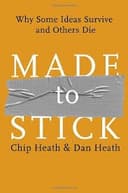
Concreteness is one of six core principles explored by Chip Heath and Dan Heath in their 2007 book *Made to Stick: Why Some Ideas Survive and Others Die*. The premise is disarmingly simple: abstract ideas slide off the brain, while concrete, sensory ideas grip it. When you tell someone their health will 'improve', their brain has almost nothing to hold onto, the phrase is so broad it could mean anything to anyone, and so it means almost nothing to anyone. But when you say 'you'll be able to sit through your daughter's school concert without shuffling in your seat', the brain lights up with a specific picture, a specific feeling, a specific person.
The psychology behind this runs deep. Human memory and motivation are fundamentally tied to sensory experience and narrative specificity. Cognitive scientists describe this as 'concreteness effect', concrete words are processed faster, remembered longer, and rated as more meaningful than abstract ones. Research in psycholinguistics has demonstrated that concrete nouns and phrases activate a broader range of neural regions, including those associated with sensory and motor processing, compared to abstract language. In short, your brain doesn't just read the word 'walk', it partially simulates walking. Abstract words like 'wellness' or 'function' trigger no such simulation.
This has direct implications for how motivation works. Behavioural scientists have long understood that people act on goals they can visualise. A patient who can picture themselves crouching down to the garden bed without their knee seizing, or lifting their grandchild without bracing for pain, has something to move toward. A patient told to 'maintain their musculoskeletal health' has an obligation, not a destination. One feels like a reward. The other feels like homework. The Heath brothers argue that concreteness isn't about dumbing ideas down, it's about making them real enough to act on.
For allied health practices, this principle cuts through one of the most persistent problems in patient communication: the gap between clinical language and lived experience. Physiotherapists think in terms of 'improving hip flexion', 'reducing neural tension', and 'restoring functional range of motion'. Patients think in terms of getting through the school run, sleeping without waking at 3am, or playing a round of golf on the weekend. Neither is wrong, but only one language re-engages a lapsed patient. When your outreach messages are built around the specific, sensory outcomes your patients actually care about, they stop feeling like administrative reminders and start feeling like someone genuinely understands what's been lost.
The Research
One of the most compelling demonstrations of concreteness in the Heath brothers' book involves a university study on charitable giving, conducted by Deborah Small, George Loewenstein, and Paul Slovic (published in 2007 in *Organizational Behavior and Human Decision Processes*). Participants were asked to donate to a famine relief cause. One group received statistical information: millions of people across several African nations were facing starvation, with specific figures on food shortages and displacement. Another group received the story of a single seven-year-old girl named Rokia from Mali, her face, her hunger, her village. A third group received both the statistics and Rokia's story together. The results were striking: the identifiable individual (Rokia) generated nearly twice the donations of the statistical information. More surprisingly, adding the statistics to Rokia's story actually reduced donations compared to her story alone.
This study illuminates something critical for allied health practice owners: abstract scale numbs people, while concrete specificity moves them. The researchers described this as the 'identifiable victim effect', we are wired to respond to vivid, specific individuals and situations far more powerfully than to aggregate data. When you send a patient a message referencing their specific limitation, their specific goal, or their specific previous experience with your practice, you are activating this same neurological response. You become Rokia. 'Improve your wellbeing' is the statistic. 'Get back to your Sunday morning run' is the story.
How to Apply This in Your Practice
The first step in applying concreteness to patient re-engagement is auditing your current outreach language. Pull up the last three SMS or email templates your practice uses to contact lapsed patients. Underline every abstract phrase: 'health goals', 'ongoing care', 'maintain progress', 'optimise function', 'overall wellbeing'. These are the phrases that register as background noise. Now ask yourself: what would this patient's life actually look like if they completed a course of treatment? What specific activity, moment, or physical sensation would be different? That answer is your message.
Practically, this means building a habit of recording patient-stated goals in your intake and clinical notes, not the clinical interpretation, but the patient's own words. When a new chiropractic patient says 'I just want to be able to turn my head properly when I'm reversing the car', write that down verbatim. When a podiatry patient mentions they've had to stop their evening walks because of heel pain, note it. When you re-engage that patient six months later, your message can reference exactly that detail: 'Hi Margaret, we noticed it's been a while since your last visit, you mentioned the heel pain was getting in the way of your evening walks. Are you managing to get out again?' This level of specificity signals that your practice sees the patient as a person, not a record number. It also makes the cost of inaction concrete: the walks aren't happening.
For practices using an automated re-engagement platform, the goal is to create a library of concrete, outcome-specific message variants tied to treatment types and patient demographics. A physiotherapy practice might develop separate messaging tracks for post-surgical rehab patients ('getting back to the gym'), older adults with osteoarthritis ('keeping up with the grandkids'), and athletes ('returning to training'). Each track uses sensory, activity-specific language rather than clinical descriptors. 'Your lower back treatment' becomes 'getting you back to the long drives on weekends'. 'Your shoulder rehabilitation' becomes 'reaching the top shelf without that sharp catch'. The more specific you can get, the more real the message feels.
There is also a timing dimension to concreteness. Concrete messages land harder when they're anchored to a specific moment the patient can relate to. Seasonal hooks work well here: 'With summer coming up, a lot of our patients are getting back into the garden, if your knees were holding you back last year, now's a good time to get ahead of it.' Or around life events: 'School holidays are a great time to sort out the things we put off during the busy term, is that shoulder still giving you trouble?' These contextual anchors don't just add warmth; they give the patient a concrete frame of reference that makes the message feel timely and personally relevant rather than automated.
Get one behavioral science principle per week
Applied to patient retention. Backed by research. No fluff.
Seeing It in Action
Consider a fictional Melbourne osteopathy clinic, BodyWise Osteopathy, whose practice manager notices that a patient named David Chen, 54, hasn't booked since his third consultation eight months ago. David originally came in with chronic lower back pain that was disrupting his sleep and making his daily commute, a 40-minute train ride, genuinely miserable. His clinical notes included a comment he made in session one: 'I just want to be able to sit at my desk without shifting around every ten minutes.' The clinic's previous re-engagement template would have sent David something like: 'Hi David, it's been a while since your last appointment at BodyWise. We recommend regular osteopathic care to maintain your progress. Book online at the link below.'
Instead, using a concrete re-engagement approach, BodyWise sends: 'Hi David, it's been about eight months since we last saw you. Last time, you mentioned the back pain was making it hard to sit comfortably at work. Are you still managing okay, or has it crept back in? Winter tends to be tough on old back injuries, happy to get you in for a tune-up if you need it.' The message is only a few words longer, but the effect is entirely different. David reads it and immediately recalls exactly what they're referring to. He has, in fact, been shifting in his chair again for the past six weeks but kept telling himself he'd deal with it later.
David replies within the hour and books for the following Tuesday. He later mentions to the treating osteopath that he almost didn't come back because he figured 'they probably wouldn't remember what was going on with me.' The concrete message proved they did. That single re-engaged patient represents several hundred dollars in revenue, but more than that, it represents a patient who now tells two colleagues about the practice because he felt genuinely seen. Concreteness didn't just re-engage David. It rebuilt trust.
Your Action Plan
- 1Audit your existing re-engagement templates and highlight every abstract phrase ('ongoing care', 'overall health', 'maintain progress'), these are your blind spots. Rewrite each one using a specific activity, sensation, or life moment a real patient would recognise.
- 2Update your intake forms and clinical note templates to include a 'Patient's Own Goal' field where you record the exact words patients use to describe what they want to get back to, not the clinical translation, but their phrase verbatim.
- 3Build a message library of concrete, outcome-specific re-engagement templates organised by treatment type and patient life stage (e.g., tradies with shoulder injuries, retirees with mobility goals, parents with postpartum back pain), aim for at least two to three variants per category.
- 4Train your front-of-house and clinical team to listen for concrete life goals during appointments and flag them in the patient record, a five-second note like 'wants to do the Camino next year' becomes gold when it's time to re-engage twelve months later.
- 5Review your re-engagement message performance monthly and A/B test abstract versus concrete versions of the same message to the same lapsed patient segment, the response rate difference will give you a direct, measurable case for doubling down on specificity.
Key Takeaway
Patients don't re-engage with vague promises of better health, they re-engage when your message makes them feel the specific, sensory gap between where they are now and the life they were trying to get back to.
Related Principles
Simplicity (Find the Core): One Message, One Action, Nothing Else
Made to Stick · Chip Heath & Dan Heath
Strip a message down to its most essential, compact form. If you say three things, you say nothing.
Unexpectedness (Surprise and Curiosity Gaps): Open with a Surprise to Keep Patients Reading
Made to Stick · Chip Heath & Dan Heath
Surprise gets attention. Curiosity gaps, opening a question without immediately answering it, keep attention.
Status Quo Bias: Why Patients Stick with Routines (and How to Use It)
Nudge · Richard H. Thaler & Cass R. Sunstein
People prefer the current state of affairs and resist change, even when change would benefit them. Disrupting their routine requires effort they instinctively a
Feedback Loops: Show Patients Their Progress to Prevent Treatment Drop-Off
Nudge · Richard H. Thaler & Cass R. Sunstein
People make better decisions when they receive clear, timely feedback on the consequences of their choices.