
Social Currency

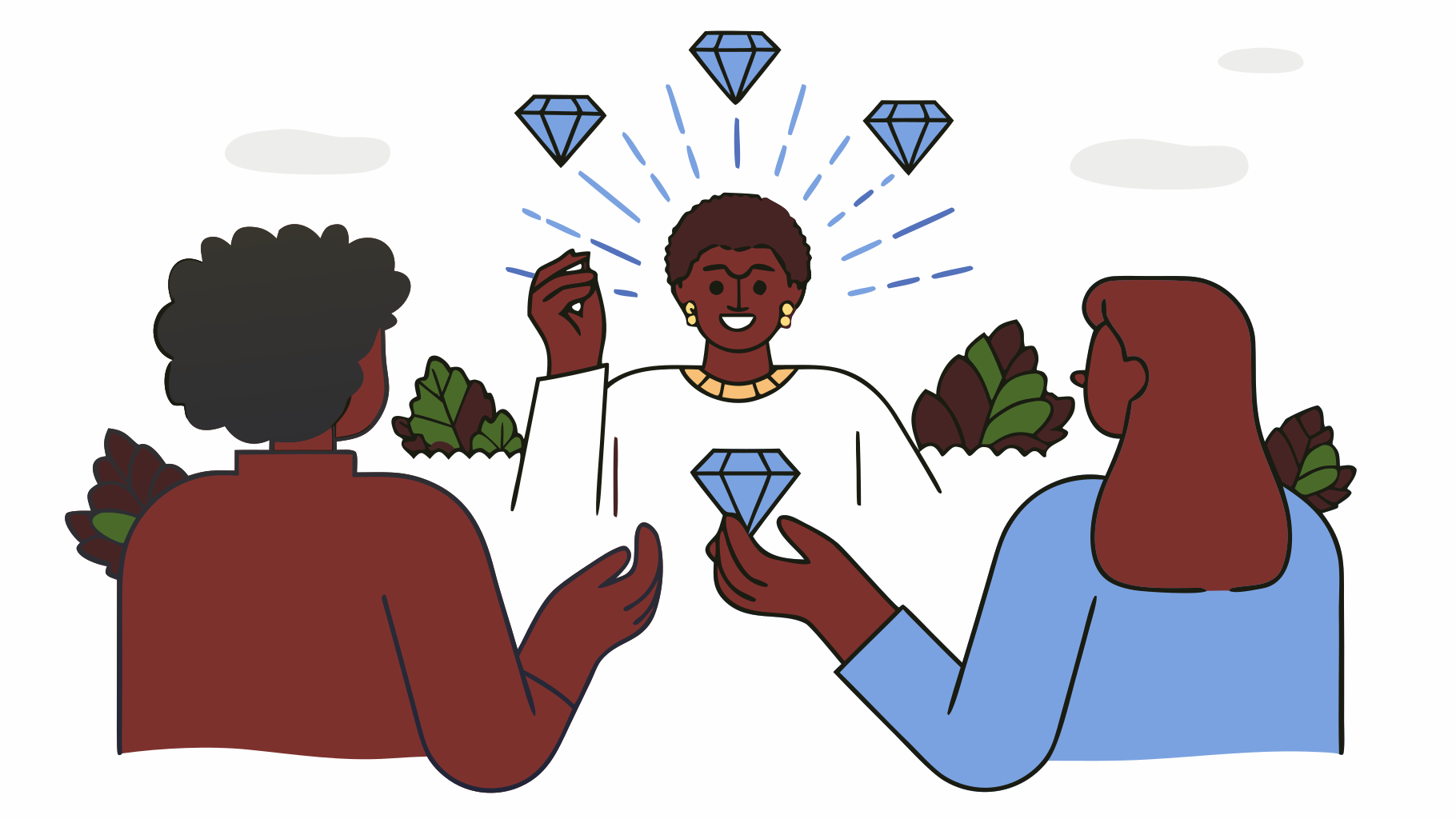
Every week, your happiest patients walk out the door and say nothing to anyone, not because they don't value what you do, but because no one gave them a reason to talk. Social Currency, a principle drawn from decades of social psychology research, explains why some health content spreads organically while most sits unseen, and why the right reactivation message doesn't just bring one patient back, it brings their entire network with them.
The Science Behind Social Currency
Social Currency is one of six principles outlined by Wharton professor Jonah Berger in his 2013 book Contagious: Why Things Catch On. At its core, the idea is deceptively simple: people share things that make them look good. Just as we choose clothes or cars to signal something about who we are, we curate what we talk about and share online to manage our social image. When someone passes along a piece of content, recommends a service, or publicly aligns with a brand, they are, consciously or not, making a statement about themselves to their peers.
The psychology behind this is rooted in self-presentation theory, developed by sociologist Erving Goffman, who argued that human beings are constantly performing for social audiences. More recent neuroscience supports this: a Harvard study found that talking about ourselves activates the same reward circuits in the brain as food or money. Sharing, in other words, is not altruism, it is self-expression dressed as generosity. This is a crucial reframe for any health practice owner who thinks word-of-mouth is outside their control.
Berger's research identified several mechanisms through which Social Currency operates. One is 'inner remarkability', the idea that content which surprises, impresses, or reveals something non-obvious gets shared because the sharer looks insightful for knowing it. Another is association with identity: people share content that signals membership in a group they aspire to belong to. For your patients, that group might be 'people who take their health seriously', 'the person at work who knows about posture', or simply 'someone who's ahead of the curve on wellness'.
The implications for patient retention are significant. Lapsed patients often drift away not because of a bad experience, but because the clinic has faded from their social and mental landscape. If you can re-enter their world through content they genuinely want to share, content that flatters their health identity, you accomplish two things simultaneously: you re-engage the lapsed patient, and you achieve organic exposure to an entirely new audience who trusts that patient's recommendation far more than any advertisement you could run.
The Research
One of the most compelling demonstrations of Social Currency in Berger's research involved a Philadelphia restaurant called Barclay Prime, which offered a $100 Philly cheesesteak. On the surface, a hundred-dollar version of a notoriously cheap street food is absurd, but that absurdity was precisely the point. Berger studied how and why the story spread, finding that people couldn't help but tell others about it. The reason wasn't the steak itself; it was that knowing about it, having tried it, made the teller seem like someone with insider knowledge and sophisticated taste. The story made the sharer look interesting.
Berger's broader research across multiple product categories consistently showed that content and products with high 'remarkability', things that give people something worth saying, were shared at significantly higher rates than objectively superior products that lacked that quality. The mechanism was always the same: the sharer gained social status by association. For a physio or chiropractic clinic, this is the research foundation you need. Your content doesn't just need to be accurate or useful, it needs to make the person who shares it look like someone worth listening to.
How to Apply This in Your Practice
The first step is to audit your patient communications through the lens of Social Currency: does this content make my patient look good if they share it? Most clinic newsletters and reactivation messages fail this test immediately. 'We miss you, book your next appointment' does nothing for the patient's social image. Compare that to a message that says: 'Here's a 90-second thoracic mobility drill your colleagues who sit at a desk will actually thank you for.' The second message is shareable because it positions the patient as someone knowledgeable and caring, qualities people actively want to project to their social circles.
For lapsed patient reactivation specifically, build a sequence that leads with shareability before it leads with a booking ask. Your first re-engagement touchpoint might be a piece of genuinely useful content, a short video, an infographic, or a brief tip, that your lapsed patient would be proud to forward. Example SMS copy: 'Hi [Name], we just put together a 2-minute morning routine for people with lower back tightness, it's become our most popular resource this year. Thought of you: [link]. Let us know if you'd like to come in and we'll personalise it for you.' This message does not ask for a booking. It offers Social Currency first, reactivating the relationship before making a commercial request.
The content itself should be engineered for identity signalling. Think about what your ideal patient wants their peers to think of them. A patient at a sports physio clinic wants to be seen as a serious, informed athlete. A patient at an osteo or massage clinic dealing with chronic desk pain wants to be seen as someone who takes proactive care of their body, not someone who just endures discomfort like everyone else. Build shareable assets around those identity aspirations: 'The desk worker's guide to not feeling 60 at 35', or '5 things runners know about knee pain that most people don't.' These titles do the Social Currency work in the headline alone.
Finally, close the loop by making sharing frictionless and explicitly invited. When a lapsed patient re-engages and has a positive appointment, that is your highest-leverage moment for Social Currency activation. Train your practitioners to say something like: 'I've got a one-page summary of what we worked on today, feel free to send it to anyone you know who deals with the same thing.' Pair this with a referral mechanism that rewards the sharer, not with a discount, which can feel transactional, but with something that reinforces their health identity, like a free posture assessment or a personalised home programme. The patient shares because it makes them look good; the referral is a by-product of that motivation.
Get one behavioral science principle per week
Applied to patient retention. Backed by research. No fluff.
Seeing It in Action
Marcus is a 38-year-old project manager who saw a chiropractor at a Melbourne-based practice, Align Health, eighteen months ago for recurring neck pain related to long hours at a standing desk. He attended six sessions, felt significantly better, and then life got busy. He stopped booking. He wasn't dissatisfied, he simply drifted. From the clinic's perspective, he was a lapsed patient. From Marcus's perspective, he barely thought about the clinic at all.
Align Health's practice manager, using a reactivation workflow built around Social Currency, sent Marcus a targeted SMS in month fourteen of his lapse: 'Hey Marcus, we put together a 90-second neck reset routine for people who spend long hours at a desk, it's been our most shared resource this quarter and a few of our patients have sent it to their whole team. Thought you'd appreciate it: [link]. We're also running a check-in appointment this month if you want us to look at how things are tracking.' Marcus watched the video, found it immediately useful, and, critically, forwarded it to two colleagues in his open-plan office with the message: 'This is actually good.' Both colleagues asked him where it came from.
Marcus booked a check-in appointment the following week. One of his colleagues booked a new patient consultation the week after. Marcus's sense of himself as a health-savvy, forward-thinking professional had been affirmed by the act of sharing, and Align Health had reactivated not just one lapsed patient, but generated a warm referral entirely through the mechanism of Social Currency. The clinic spent nothing on advertising. They simply gave Marcus something worth saying.
Your Action Plan
- 1Audit every current reactivation message you send and ask one question, 'Would a patient share this with a colleague or friend, and would doing so make them look good?' If the answer is no, the message needs to be rebuilt around a Social Currency offer before a booking call-to-action.
- 2Create three to five pieces of shareable content assets tailored to your patient archetypes, for example, a desk-worker stretch sequence, a post-run recovery checklist, or a sleep position guide for people with lower back pain. Each piece should have a title that signals identity ('What people who manage chronic pain actually do differently').
- 3Build a reactivation SMS or email sequence where the first message in the series delivers one of these shareable assets with no booking ask, and includes explicit language inviting the patient to forward it to someone who would benefit.
- 4At the end of each appointment with a returning or re-engaged patient, hand them a physical or digital one-pager summarising their care plan and tell them directly that they're welcome to share it with anyone dealing with a similar issue, this is your highest-conversion Social Currency moment.
- 5Track which pieces of shared content generate new patient enquiries by asking every new patient 'How did you hear about us?' and recording 'referred by patient who shared content' as a distinct category, this lets you identify which assets have the highest Social Currency and double down on that format.
Key Takeaway
When you give your patients content that makes them look knowledgeable and health-savvy to the people around them, you don't just reactivate one lapsed patient, you turn their entire social network into a warm referral pipeline, powered by a psychological drive that costs you nothing to activate.
Related Principles
Triggers (Environmental Reminders): Link Rebooking to Everyday Physical Sensations
Contagious · Jonah Berger
Ideas spread when they are linked to frequent environmental triggers. The more often something is triggered, the more it stays top-of-mind.
Practical Value: Send Useful Content to Stay Relevant Between Visits
Contagious · Jonah Berger
People share information that is genuinely useful. Practical content travels farther than promotional content.
Social Proof: Show Patients That Others Complete Treatment
Influence · Robert B. Cialdini
People look to what others are doing to determine correct behavior, especially in uncertain situations.
Commitment and Consistency: Get Verbal Commitments to Increase Follow-Through
Influence · Robert B. Cialdini
Once people make a commitment (especially publicly or in writing), they feel internal pressure to behave consistently with it.