
WYSIATI (What You See Is All There Is)
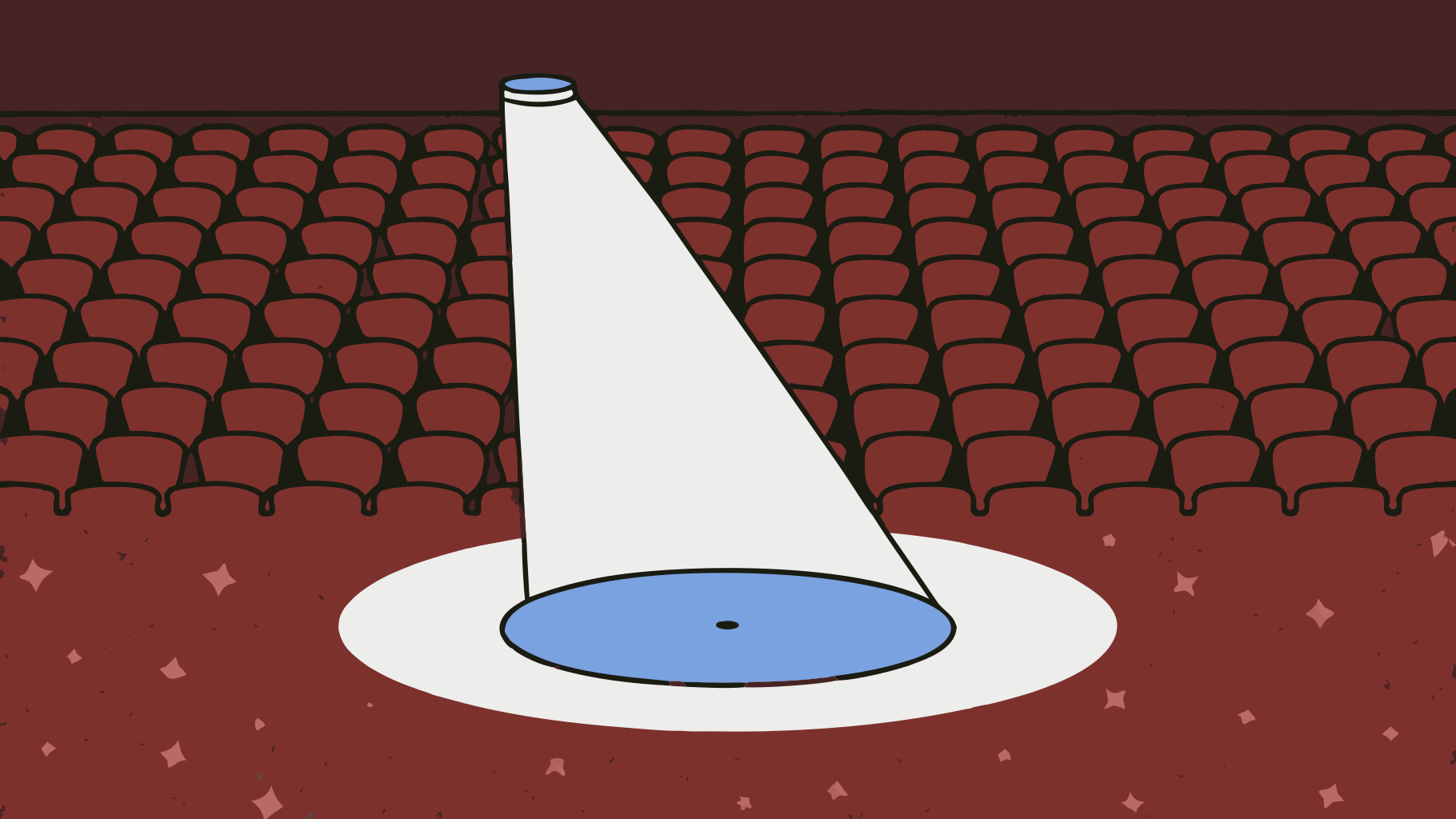
A patient comes to your clinic with acute back pain, completes six sessions, feels dramatically better, and then... vanishes. Six months later, their pain returns, but they book with a competitor down the road. They didn't leave because they were unhappy with your care. They left because, cognitively speaking, you ceased to exist. This is the quiet crisis hiding inside every allied health practice's patient database, and behavioural science has a precise explanation for why it happens.
The Science Behind WYSIATI (What You See Is All There Is)
WYSIATI, What You See Is All There Is, is one of the most consequential cognitive principles uncovered by Nobel Prize-winning psychologist Daniel Kahneman, introduced in his landmark 2011 book *Thinking, Fast and Slow*. The principle describes a fundamental flaw in human reasoning: our minds construct a coherent picture of reality using only the information that is currently available to us, without pausing to ask what we might be missing. We don't think, 'I wonder what else is relevant here.' We simply work with what's in front of us and treat it as the whole story. Kahneman described this as the signature move of System 1, the fast, automatic, associative thinking that governs the vast majority of our daily decisions.
The psychological mechanism at work is what Kahneman calls 'cognitive ease.' Our brains are wired to prefer coherent narratives over incomplete ones. When information is absent, we don't feel a gap, we simply don't notice the gap exists. The mind fills in nothing; it just proceeds with confidence using whatever is present. This is why eyewitness testimony is notoriously unreliable (witnesses report what they saw, not what they didn't see), why investors make poor decisions based on recent market data alone, and why patients who felt better after physiotherapy genuinely don't think about returning, because the cue to return simply isn't there. Out of sight isn't just out of mind; it's as though the option never existed.
This has profound implications for how patients experience the relationship with your practice between appointments. When a patient is actively attending sessions, your clinic exists vividly in their mental model. Your name is in their calendar, your number is in their recent calls, your advice is shaping their daily routine. But the moment that active contact stops, you begin to fade. Not because they made a conscious decision to move on, but because WYSIATI dictates that their world is now constituted entirely of what is in front of them. Their attention is captured by work deadlines, family commitments, and the immediate absence of acute pain. Your clinic isn't part of that visible landscape, so it simply isn't part of their thinking.
The critical insight for practice owners is this: lapsed patients are not making an active decision to disengage. Passive forgetting is not the same as active rejection. Research in cognitive psychology consistently shows that salience, how mentally present something is, is one of the strongest predictors of whether a person will act on something. If your practice has low salience in a patient's life, it is effectively invisible to their decision-making. The solution, then, is not to provide better clinical outcomes (you're already doing that), it's to engineer consistent, low-friction moments of visibility that keep you inside their mental model.
The Research
The most well-known experimental demonstration of WYSIATI comes from Kahneman and Amos Tversky's extensive research programme on heuristics and biases, specifically their work on the 'Linda problem,' published in their seminal 1983 paper in *Psychological Review*. Participants were given a description of a woman named Linda, described as outspoken, deeply concerned with social justice, and involved in anti-nuclear activism as a student, and then asked which was more probable: that Linda was a bank teller, or that Linda was a bank teller who was also active in the feminist movement. An astonishing 85% of participants chose the second option, even though it is statistically impossible for a conjunction of two events to be more probable than either event alone. The reason they got it wrong was WYSIATI in action: the vivid description of Linda made feminist-related information highly available, and participants built their judgement entirely on that available picture, ignoring the underlying probability structure they weren't actively considering.
What this demonstrates, and what is directly transferable to patient behaviour, is that people do not reason from a complete information set. They reason from whatever is mentally activated at the moment of judgement. For your lapsed patients, when they feel a familiar ache six months after discharge, the information most available to them is whatever is salient right now: perhaps a friend's recommendation, a Google search result, or a competitor's social media ad they saw that morning. If your practice isn't part of that activated information set, you will not factor into their decision, not because of any failing on your part, but because of a hardwired feature of human cognition.
How to Apply This in Your Practice
The first strategic shift is to stop thinking about patient communication as something that happens reactively, triggered only by bookings, reminders, or complaints, and start thinking about it as an ongoing presence management system. Because WYSIATI means patients only consider what is mentally visible, your job is to remain a gentle, consistent presence in their peripheral awareness, even when they have no immediate clinical need. This doesn't require aggressive marketing. It requires thoughtful, low-frequency touchpoints that feel like care rather than sales. Research in behavioural science suggests that mere exposure, simply being seen or heard regularly, increases familiarity and positive association. For allied health, this translates directly to retention.
Practically, this means designing a post-discharge communication sequence that spans months, not days. For a patient who completed a shoulder rehabilitation programme, your workflow might look like this: a check-in message at the two-week mark ('Hi Sarah, just checking in, how is the shoulder feeling since your last session? Remember, those rotator cuff exercises work best when continued for at least six weeks.'), a seasonal tip at the three-month mark ('Heading into winter? Cold weather can tighten the muscles around old injuries, here's one stretch we recommend for shoulder health this season.'), a birthday message in whatever month their birthday falls, and an annual check-up prompt linked to the anniversary of their initial presentation. None of these messages need to be long. A two-sentence SMS or a personalised email subject line, 'Just thinking of you, Sarah', is enough to activate recognition and salience. The goal is not to overwhelm; it's to exist.
The content of your touchpoints matters because WYSIATI also governs how patients evaluate their health. If a patient never receives information about the connection between, say, foot mechanics and lower back pain, that connection simply will not exist in their mental model, even if it is clinically relevant to them. A podiatry practice that sends a monthly wellness tip about how footwear choices affect posture is actively constructing a richer, more accurate picture of health in their patients' minds. When that patient's back starts aching, they now have an available cognitive pathway that leads back to the clinic. You are not manipulating them; you are filling in genuine gaps in their health literacy that, left unfilled, leave WYSIATI to work against you.
From a workflow perspective, the most effective approach is to automate the cadence while personalising the content. Tools like Routiq allow you to segment your lapsed patient database by condition, discharge date, age group, or last treatment type, and trigger sequences accordingly. The segmentation matters because WYSIATI responds to relevance, a message about knee osteoarthritis management will activate far more salience for a 58-year-old runner than for a 28-year-old who came in for a sports massage. Specificity signals that you remember the patient as an individual, which itself is a powerful retention driver. Map out your patient journey in three stages: active care, post-discharge (zero to three months), and lapsed (three months or more), and design distinct communication touchpoints for each stage so no patient ever fully disappears from your awareness map, or from theirs.
Get one behavioral science principle per week
Applied to patient retention. Backed by research. No fluff.
Seeing It in Action
Marcus, a 44-year-old project manager, first attended Northside Physiotherapy after a disc bulge left him barely able to get out of bed. Over eight sessions with his physio, Claire, he made a remarkable recovery, returning to the gym, sleeping through the night, and feeling, in his words, 'like a different person.' He was discharged with a home exercise programme and told to return if symptoms flared. Claire's clinic, like most, had no structured post-discharge communication in place. Life moved on. Marcus's diary filled up, the exercises slipped, and within four months, Northside Physiotherapy had effectively ceased to exist in his daily mental landscape.
Eight months after discharge, Marcus felt that familiar stiffness returning after a long interstate flight. He picked up his phone and Googled 'physio near me.' The first result was a competitor clinic with a prominent ad. He booked there that afternoon, not because of any dissatisfaction with Claire's care, but simply because WYSIATI had erased Northside from his available options at the critical moment of need. Claire never knew he had returned to the market. This is the invisible attrition that bleeds revenue from practices every single week.
In a parallel scenario, one where Northside had implemented a simple post-discharge sequence, Marcus would have received a two-week check-in from Claire, a three-month email with a tip about travel ergonomics and lumbar support ('Frequent flyer? Here's what your spine needs before a long-haul flight'), and a six-month seasonal check-in as winter approached. When his stiffness returned after that flight, the most recent health communication in his inbox was from Claire. Her name was the most salient option available. He replied to the email within twenty minutes, rebooked, and later referred two colleagues. The clinical care was identical in both scenarios. The only difference was visibility, and visibility, as WYSIATI teaches us, is everything.
Your Action Plan
- 1Audit your lapsed patient database, identify every patient who has not booked in the past 90 days and segment them by condition type, discharge date, and age group so your reactivation messages can be relevant rather than generic.
- 2Design a three-stage post-discharge communication sequence (2-week check-in, 3-month wellness tip, 6-month seasonal prompt) and write template messages for your top three most common presenting conditions, back pain, sports injuries, and chronic joint issues are a strong starting point.
- 3Add low-effort 'salience touchpoints' to your annual calendar, birthday messages, seasonal health tips tied to your patient cohort (e.g., 'heading into the footy season?' for a sports-heavy clinic), and condition-relevant awareness moments that feel like genuine care rather than promotional outreach.
- 4Automate the sequence using a patient engagement platform so that communication continues even when your front desk is busy, the consistency of touchpoints matters more than their polish, and automation ensures no patient silently lapses without a nudge.
- 5Review your reactivation metrics quarterly, track open rates, reply rates, and rebooking conversions from each touchpoint to identify which messages are generating the most salience and refine your sequence based on real patient behaviour data.
Key Takeaway
Your lapsed patients haven't chosen a competitor, they've simply forgotten you exist, and the only antidote to WYSIATI is making your practice a consistent, visible presence in their mental world long after they leave your treatment table.
Related Principles
System 1 vs. System 2 Processing: Design Messages for Fast, Intuitive Patient Decisions
Thinking, Fast and Slow · Daniel Kahneman
Most daily decisions are made by the fast, automatic System 1. People don't deliberate about routine health appointments, they either have an automatic habit
Loss Aversion: Frame What Patients Lose to Drive Rebooking
Thinking, Fast and Slow · Daniel Kahneman
People feel the pain of losing something roughly twice as strongly as the pleasure of gaining the equivalent. Losses loom larger than gains.
Status Quo Bias: Why Patients Stick with Routines (and How to Use It)
Nudge · Richard H. Thaler & Cass R. Sunstein
People prefer the current state of affairs and resist change, even when change would benefit them. Disrupting their routine requires effort they instinctively a
Feedback Loops: Show Patients Their Progress to Prevent Treatment Drop-Off
Nudge · Richard H. Thaler & Cass R. Sunstein
People make better decisions when they receive clear, timely feedback on the consequences of their choices.