
External and Internal Triggers
A patient books six consecutive appointments, responds well to treatment, then simply disappears, no cancellation, no complaint, no explanation. Three months later, they're still on your books as 'active,' but the truth is you've already lost them. The trigger system that brought them through your door in the first place has quietly collapsed, and without a deliberate strategy to rebuild it, that patient will likely seek care elsewhere the next time their back seizes up or their knee flares.
The Science Behind External and Internal Triggers
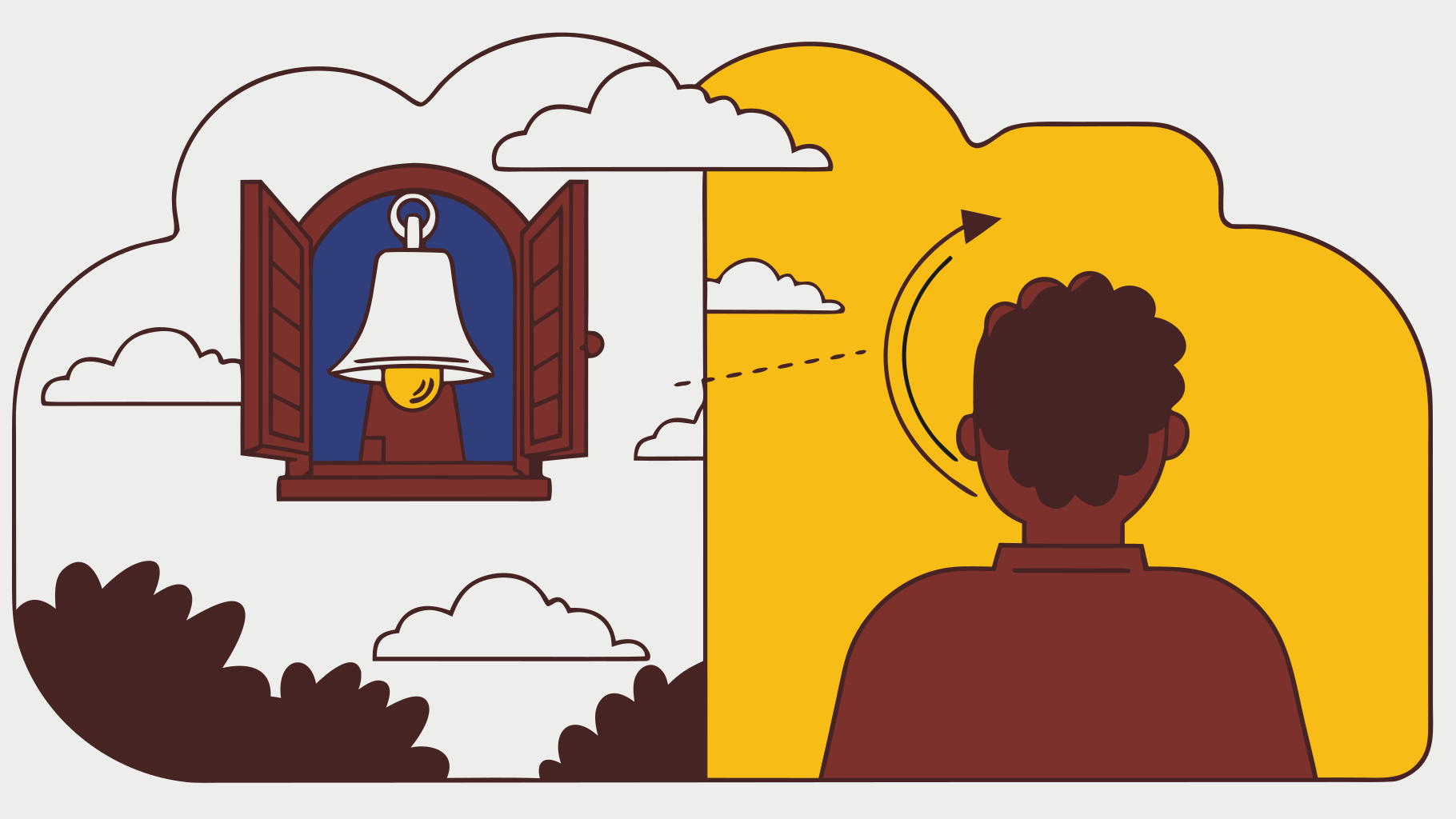
The psychology here is rooted in classical conditioning and associative learning. Each time a behaviour is performed in response to a cue and followed by a reward, the neural pathway connecting that cue and behaviour strengthens. Over time, the external cue becomes less necessary because the internal state, say, the familiar Monday morning stiffness or the post-long-run ache in the Achilles, itself becomes the trigger. The person no longer needs a reminder to book their appointment; the sensation prompts the behaviour automatically. This is why your most loyal, long-term patients rarely need re-engagement campaigns. Their body has essentially become the reminder system.
For lapsed patients, Eyal's framework reveals something important that pure scheduling logic misses: the problem is not just that they forgot to book. The problem is that both layers of the trigger system have gone dark simultaneously. The external trigger, your follow-up call, the routine appointment card, stopped arriving. And without reinforcement, the internal trigger, the association between 'I feel stiff' and 'I should call the clinic', was gradually overwritten by other associations or simply faded through disuse. Research in habit formation suggests it takes an average of 66 days for a behaviour to become automatic (Lally et al., 2010, University College London), but that automaticity is also reversible when the habit loop is broken for an extended period.
This creates a specific rehabilitation challenge. You cannot simply send a lapsed patient a generic 'we miss you' email and expect the old habit to reinstall itself. The internal trigger that once drove their visits, pain, stiffness, performance anxiety before sport, the post-adjustment relief they associated with wellbeing, needs to be deliberately re-activated. The external trigger you send needs to speak directly to that internal state, not to your business need to fill an appointment slot. Eyal's model makes the direction of causality clear: the external trigger must resonate with an internal state the patient is already experiencing for it to produce action.
The Research
The most instructive real-world demonstration of trigger dynamics from Eyal's own research in *Hooked* involves the behavioural patterns observed at companies like Instagram and Twitter during their early growth phases. Eyal documents how these platforms invested heavily in external triggers, push notifications, email digests, SMS alerts, not because they were intrinsically valuable, but because each notification served as a rehearsal, training users to associate an internal state (boredom, loneliness, curiosity) with the behaviour of opening the app. The external trigger's job was not to be useful forever; its job was to install the internal trigger and then become redundant. This mechanism mirrors the finding from Phillippa Lally's 2010 UCL study, which tracked 96 participants forming new habits over 12 weeks and found that missing a single repetition did not meaningfully disrupt habit formation, but extended gaps did erode automaticity significantly. The implication for patient retention is direct: it is not one missed appointment that breaks the habit loop, but the accumulation of missed external triggers during that gap that allows the internal trigger to decouple from the behaviour of booking care.
How to Apply This in Your Practice
The strategic starting point for any lapsed patient re-engagement campaign is segmentation by internal trigger type, not simply by time since last visit. Before you send a single message, review your patient notes and ask: what originally brought this person in? A tradie with chronic lower back pain has a very different internal trigger profile than a recreational runner managing plantar fasciitis or an office worker seeking relief from tension headaches. The internal trigger for the tradie is likely a specific physical sensation, that grinding tightness after a long shift. Your external trigger needs to name that sensation explicitly to create recognition and resonance.
At the message level, this means moving away from administrative language ('You have not visited us in 90 days') and toward sensory, emotionally precise copy that mirrors the patient's likely internal experience. For a patient who regularly attended for cervicogenic headaches and has been lapsed for eight weeks, a well-timed SMS might read: 'Noticed that end-of-week headache creeping back in? It might be time to get those upper traps looked at, [Practitioner Name] has availability this Thursday.' For a patient who came in post-marathon training, the trigger might be timed to race season: 'Training ramps up in spring, is your body ready for it? Book a movement screen before the niggles turn into something bigger.' The message is not selling a service; it is naming the internal state the patient is likely already experiencing and positioning your practice as the logical response to it.
Timing is the other critical variable Eyal's framework highlights. External triggers work best when they arrive at the moment the internal trigger is most likely to be active. For a patient with Monday morning stiffness, a Sunday evening SMS will dramatically outperform a Wednesday afternoon one. For a patient who trains on weekends and struggles with post-exercise soreness, a Monday message, when the soreness has peaked and the internal trigger is loudest, is strategically superior. This requires your practice management system or CRM to allow sending at custom times, but the behavioural payoff makes the setup worthwhile. Routiq's platform is built around exactly this kind of trigger-aligned sequencing, allowing you to schedule outreach to coincide with the predictable rhythms of each patient's original pain pattern.
Finally, the re-engagement sequence itself should be designed as a trigger reconstruction programme, not a single message. Eyal's research shows that internal triggers are rebuilt through repetition of the external trigger paired with action and reward. Your first message reactivates awareness. If the patient books and attends, the clinical outcome, reduced pain, improved mobility, the physical relief of a good treatment, reactivates the reward memory that originally built the habit. If they do not respond, a second message 10-14 days later should approach the internal trigger from a slightly different angle: not 'come back because you're overdue' but 'here's what you might be missing.' By the third touchpoint, you can introduce social proof or a low-friction offer, a discounted review appointment framed as a 'check-in' rather than a full clinical session, to lower the activation energy required to re-enter care.
Get one behavioral science principle per week
Applied to patient retention. Backed by research. No fluff.
Seeing It in Action
Marcus is a 38-year-old high school PE teacher and weekend club cyclist who attended a chiropractic clinic in Melbourne for seven months, initially presenting with lumbar discomfort that flared during long rides. His treating chiropractor, Dr Priya Nair, saw him fortnightly through winter and spring. He responded well, reported significant improvement, and then, after a holiday in January and a busy return to the school term, simply stopped booking. By April, he was three months lapsed. A standard recall report flagged him as overdue, and the front desk sent a generic 'we'd love to see you again' email. No response.
Routiq's behavioural sequencing identified Marcus as a high-engagement, activity-linked patient with a seasonal pain pattern. An SMS was scheduled for the first Sunday evening of April, the beginning of the autumn cycling season when road cyclists typically ramp up their weekend mileage, reading: 'Back on the bike for autumn rides, Marcus? That lumbar stiffness has a way of returning when the kilometres do. Dr Priya has a Tuesday morning slot this week if you want to get ahead of it.' The message landed on a Sunday night when Marcus had just returned from a 70km group ride and was, in fact, noticing the familiar tightness across his lower back.
He booked the next morning. At his review appointment, Dr Nair noted he had lost some of the mobility gains from his previous treatment course, but nothing that couldn't be addressed in two to three sessions. Marcus left with a fortnightly standing appointment locked in through winter and a genuine understanding of why maintaining care through the off-season would protect his riding season. He has not lapsed since. The re-engagement was not luck, it was the product of understanding that Marcus's internal trigger (the physical sensation of post-ride stiffness) had never actually disappeared; it had simply stopped being connected to the behaviour of booking care. One precisely timed external trigger, worded to name his internal state, was enough to rebuild the bridge.
Your Action Plan
- 1Segment your lapsed patient list by original presenting complaint and visit pattern, not just by time since last visit, this tells you what internal trigger originally drove their attendance and gives you the raw material for personalised outreach.
- 2For each segment, identify the most likely moment when their internal trigger is active (e.g., Monday morning for stiffness sufferers, post-weekend for athletes, end of the work week for stress-related presentations) and schedule your first re-engagement SMS to arrive at that specific time.
- 3Write message copy that names the patient's probable internal state, a physical sensation, a routine disruption, a performance concern, rather than referencing your administrative need to fill appointments or their overdue status.
- 4Build a three-touchpoint re-engagement sequence spaced 10-14 days apart, with each message approaching the internal trigger from a slightly different angle: first, recognition of their likely experience; second, a reminder of the outcome they previously achieved; third, a low-friction offer such as a discounted review appointment or a 'movement check-in' to reduce activation energy.
- 5When a lapsed patient returns, treat that first appointment as a trigger-reconstruction session, ensure the clinical outcome is strong, reinforce the link between the treatment and the relief they feel, and book their next appointment before they leave to re-establish the external trigger chain before the internal trigger has a chance to decouple again.
Key Takeaway
A lapsed patient hasn't lost interest in their health, they've lost the trigger system that connected their pain to your practice, and your job is to rebuild it one precisely timed, emotionally resonant message at a time.
Related Principles
Reducing Action Barriers (Simplicity): Make Rebooking Effortless with One-Tap Links
Hooked · Nir Eyal
The easier an action is to perform, the more likely it is to happen. Fogg's principle: Behavior = Motivation x Ability x Prompt.
Variable Rewards: Keep Patients Engaged with Unpredictable Value
Hooked · Nir Eyal
Unpredictable rewards are more engaging than predictable ones (the slot machine effect). The brain's dopamine system responds most strongly to anticipation and
Make It Obvious (Cue Design): Reintroduce Cues to Restart the Appointment Habit
Atomic Habits · James Clear
Habits are triggered by cues. If the cue is invisible, the habit dies. Lapsed patients have lost the environmental and calendar cues that prompted their visits.
Make It Attractive (Temptation Bundling): Bundle Rewards to Make Rebooking Irresistible
Atomic Habits · James Clear
Pair a behavior you need to do with one you want to do. Link the less appealing action with something enjoyable.