
Make It Social (Peer Norms)
What if the single most powerful thing you could say to a lapsed patient wasn't a clinical recommendation, a discount offer, or a heartfelt personal message, but simply telling them what their peers are already doing? Decades of behavioural science research confirm that humans are fundamentally social creatures who calibrate their own behaviour against those around them, and allied health practices that understand this are quietly outperforming their competitors on patient retention without spending a cent more on marketing.
The Science Behind Make It Social (Peer Norms)
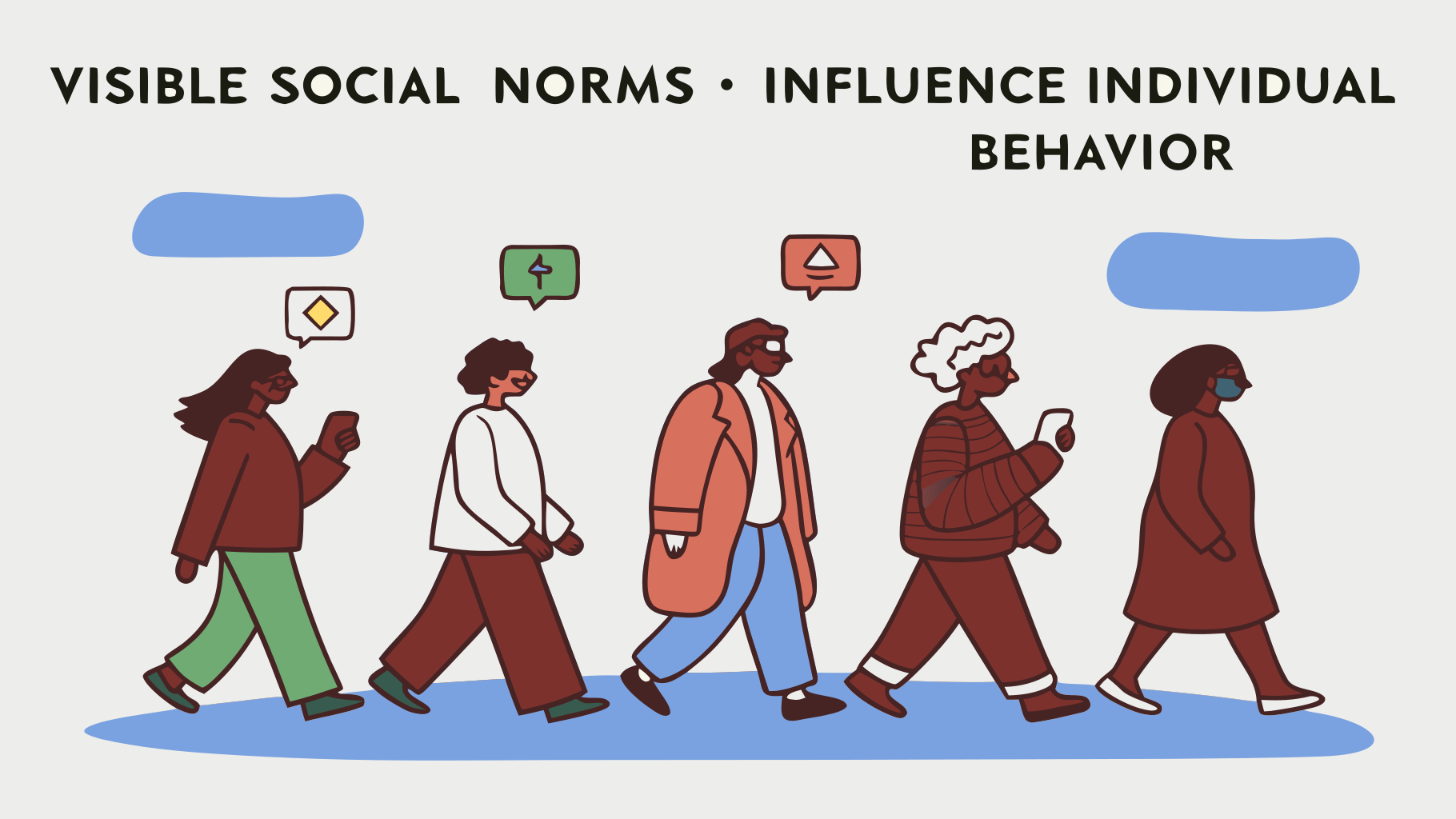
The principle of social norms, sometimes called 'peer norms' or the 'descriptive norm effect', rests on a deceptively simple insight: we don't just make decisions based on our own preferences or the instructions we receive. We make them by constantly scanning our environment to understand what other people like us are doing, and then adjusting our behaviour to match. This is not weakness or irrationality. It is a deeply adaptive cognitive shortcut that allowed humans to navigate complex social environments for thousands of years. When we see that most people in our reference group behave a certain way, that behaviour feels safe, normal, and correct, and deviating from it feels uncomfortable.
David Halpern, who led the UK government's Behavioural Insights Team (colloquially known as the 'Nudge Unit'), documents this phenomenon extensively in his 2015 book. The team's work drew heavily on earlier foundational research by social psychologists Robert Cialdini, Noah Goldstein, and Steve Martin, who distinguished between two types of social norms. Injunctive norms tell people what they *should* do, they carry moral weight but often feel like nagging. Descriptive norms tell people what others *actually* do, and these turn out to be substantially more persuasive, because they provide social proof rather than social pressure. The difference is subtle but the effect on behaviour is dramatic.
Research in this area has produced some striking numbers. Studies show that simply reframing a message to include descriptive norm information, 'most people do X' rather than 'you should do X', can shift compliance rates by 10 to 30 percentage points in some contexts. The effect is particularly strong when the reference group is perceived as similar to the person receiving the message. A physiotherapy patient is more influenced by what other physiotherapy patients do than by what 'most people' do in general. This means the more specific and locally relevant your norm statement is, the more motivating it becomes. Telling a 55-year-old with chronic lower back pain what other patients *just like them* do is far more compelling than a generic statistic.
Critically, social norms work in both directions. When people discover they are already doing *better* than the norm, they sometimes relax their behaviour, a phenomenon called the 'boomerang effect.' This is why effective application always pairs a descriptive norm with a positive signal affirming the desired behaviour. For allied health practices, the implication is clear: you need to be deliberate and strategic about which norms you surface, how you frame them, and which patient segments you target with which messages.
The Research
One of the most cited real-world demonstrations of descriptive norms comes from a study conducted by Robert Cialdini and colleagues, published in the Journal of Consumer Research (2008), which examined energy conservation behaviour in a California neighbourhood. Residents received different types of door hanger messages encouraging them to reduce energy use. One group received an injunctive message about environmental responsibility. Another received a descriptive norm message: 'The majority of your neighbours use fans instead of air conditioning to keep cool.' When researchers measured actual energy consumption, the descriptive norm message outperformed all other framings, including appeals to environmental values, cost savings, and social responsibility, by a significant margin. The norm message reduced energy consumption measurably more than any instruction or moral appeal.
What made this study particularly influential for the Nudge Unit was the finding that the *specific social referent* mattered enormously. When the norm referenced 'your neighbours', a close, identifiable peer group, it was far more effective than referencing a more distant group. Halpern's team applied this insight across dozens of government interventions, from tax compliance to hospital appointment attendance, consistently finding that localised, specific norm statements outperformed generic ones. For allied health practices, this translates directly: 'patients at our clinic who complete their rehabilitation plan' is more persuasive than 'most patients generally,' and 'patients recovering from the same knee surgery as you' is more persuasive still.
How to Apply This in Your Practice
The most immediate way to apply peer norms in your practice is to audit the language in your re-engagement communications and systematically replace injunctive statements with descriptive ones. Instead of 'We recommend completing your full course of treatment,' try: '9 out of 10 patients who complete their treatment plan with us report staying pain-free for 12 months or more.' Instead of 'It's important not to let too much time lapse between appointments,' try: 'Most of our patients book their follow-up within three weeks, and they tell us that's when they notice the biggest difference.' You are not changing your clinical advice; you are changing the social frame around it, which makes the desired behaviour feel normal rather than optional.
For lapsed patient re-engagement specifically, the norm statement needs to do two things simultaneously: make completing care feel like the majority behaviour, and make dropping off feel like the exception. A well-crafted SMS or email to a patient who hasn't been in for 8 weeks might read: 'Hi [Name], just checking in, most patients in your situation find that a check-in around this time helps them maintain the progress they worked so hard for. In fact, over 80% of patients who pop in for a maintenance session tell us they avoided a flare-up they would otherwise have had. Would you like to book in?' Notice that the message never says 'you should come back.' It simply describes what other similar patients do, and allows the patient to draw their own conclusion.
Segmentation is essential to maximising the norm effect. The more your patient recognises themselves in the reference group, the more powerful the norm becomes. This means your practice management software or CRM should allow you to tag patients by condition, age bracket, treatment type, or injury category, and then send norm-based messages that reflect their specific peer group. A 40-year-old runner with plantar fasciitis should receive a different norm statement than a 70-year-old recovering from hip replacement surgery, even if the desired behaviour (completing their care plan) is identical. Routiq's automated re-engagement workflows make this segmentation practical at scale, so you're not manually personalising every message.
Finally, consider using social norms proactively at the point of discharge or at the end of an initial treatment block, not just reactively when someone has already lapsed. When a patient is wrapping up a course of treatment, a clinician saying 'The majority of patients in your situation book a maintenance check at the three-month mark, and they consistently tell us it's the single thing that prevents re-injury' is planting a descriptive norm seed that shapes future behaviour before lapsing even begins. Front-loading the norm at the right clinical moment is arguably more powerful than using it to recover a patient who has already disengaged.
Get one behavioral science principle per week
Applied to patient retention. Backed by research. No fluff.
Seeing It in Action
Marta, 48, presented to a suburban physiotherapy clinic in Brisbane with recurring neck pain stemming from long hours at her desk. She completed an initial five-session treatment block, experienced significant relief, and was advised to book a review appointment six weeks later. Life got busy, a work deadline, school holidays, and the general friction of scheduling, and six weeks became twelve. The clinic's previous approach would have been a generic SMS: 'Hi Marta, we notice it's been a while. Please call us to book your next appointment.' Marta read it, thought 'I should do that,' and didn't.
This time, the clinic was using a norm-based re-engagement sequence through Routiq. At the 10-week mark, Marta received a message that read: 'Hi Marta, just thinking of you, most of our patients with desk-related neck pain find that a check-in around this time helps lock in the progress they made. In fact, around 85% of patients who come in for that follow-up tell us they avoided a full relapse. We have a spot on Thursday at 11am that would suit you perfectly, want us to hold it?' The message wasn't pushy. It didn't tell Marta what she should do. It simply told her what patients like her actually do, and suddenly, not booking felt like the odd choice.
Marta booked the Thursday appointment. At the session, her physio reinforced the norm again: 'You've done really well, most patients who come in at this stage feel exactly like you do, that the pain is manageable. That's actually the best time to lock it in with one more session in three months.' Marta left with a future appointment already in the diary. Twelve months later, she remains an active patient attending quarterly maintenance sessions, not because she was lectured about the importance of physiotherapy, but because her own behaviour was gently reflected back to her through the behaviour of people just like her.
Your Action Plan
- 1Audit your current re-engagement messages and highlight every injunctive statement ('you should,' 'it's important to,' 'we recommend'), then rewrite each one as a descriptive norm ('most patients in your situation,' 'X out of 10 patients who do this find that...').
- 2Gather your own practice data on treatment completion rates, re-injury prevention, and patient outcomes, even approximate figures like '8 out of 10 patients' or 'the majority of our patients' give you credible, localised norm material that is far more persuasive than generic statistics.
- 3Segment your lapsed patient list by condition, age bracket, or treatment type so that your norm statements reference a peer group the patient genuinely identifies with, a runner should hear about other runners, a post-surgical patient should hear about others who've had the same procedure.
- 4Build norm-based language into your discharge and end-of-treatment conversations, not just your re-engagement sequences, prime the norm before a patient lapses by telling them what most patients in their situation do next, making future re-booking feel like the default rather than the exception.
- 5Set up automated re-engagement workflows (using a platform like Routiq) that trigger norm-based messages at the 6, 10, and 16-week marks post-appointment, with different norm statements tailored to each patient segment, so the right social proof reaches the right patient at the right moment without requiring manual effort.
Key Takeaway
When you tell a lapsed patient what other patients just like them are already doing, you are no longer asking them to comply with your advice, you are inviting them to belong to a group, and that is a far more powerful motivator than any clinical instruction you could give.
Related Principles
Make It Easy (Friction Reduction): Reduce Rebooking to Three Taps or Fewer
Inside the Nudge Unit · David Halpern
The single most important factor in behavior change is reducing friction. Even tiny barriers stop people from acting.
Make It Attractive (Salience and Presentation): Make Re-Engagement Feel Personal, Not Broadcast
Inside the Nudge Unit · David Halpern
People respond to how something is presented, not just what it is. Visual design, personalization, and framing all affect engagement.
Social Proof: Show Patients That Others Complete Treatment
Influence · Robert B. Cialdini
People look to what others are doing to determine correct behavior, especially in uncertain situations.
Commitment and Consistency: Get Verbal Commitments to Increase Follow-Through
Influence · Robert B. Cialdini
Once people make a commitment (especially publicly or in writing), they feel internal pressure to behave consistently with it.